Best Air Pump for Floaties: Quick Inflate Solutions for Pools, Camps, and More
Answering your search for reliable air pumps for floaties, this guide highlights top choices that efficiently inflate and deflate pool floats, air mattresses, and camping gear. Each product is suited to different buyers—budget-minded shoppers, frequent campers, outdoor families, and compact-travel users. Below is a concise product table to compare what matters most: power, speed, nozzle options, and portability.
| Product | Best For | Key Benefit |
|---|---|---|
| Motorenbau Electric Air Pump | Families with varied inflatables | Three nozzle sizes + quick-fill, strong airflow |
| ETENWOLF AIR 3 | Tech-friendly campers | 2600 mAh battery, fast inflate/deflate, USB-C charging |
| Newpol Inflatable Bed Pump | Home and travel use | AC/DC power adapters, versatile with multiple inflatables |
| HYVOHEX Portable Air Pump | Outdoor adventurers | 4000 mAh battery, high airflow, heat-dissipation design |
| FLEXTAILGEAR Portable Air Pump | Ultra-portable needs | Mini size, rechargeable, simple single-button use |
Motorenbau Electric Air Pump for Inflatables

This pump offers three nozzle sizes (S, M, L) with secure locks and a long AC power cord. It’s designed for quick inflation and deflation of inflatables such as air mattresses, pool floats, boats, and cushions. Best for households with multiple inflatables that use different valve sizes. A caution: not rechargeable and not suitable for high-pressure items like balloons or tyres.
ETENWOLF AIR 3 Air Pump

ETENWOLF AIR 3 features a 2600 mAh battery with a 0.65 PSI rating and 13 CFM, enabling fast inflation and deflation. It can inflate an air mattress in about a minute and deflate in under a minute. It’s ideal for independent use away from wall outlets and for users who want quick turnaround between inflatables. Note: Not suitable for SUPs or sport balls; power management requires unplugging before turning it on after charging.
Newpol Inflatable Bed Pump

Newpol provides both AC and DC power options (110-240V and 12V) for versatile use at home or on the road. It supports inflating beds, pools, rings, boats, and more. Includes three nozzle sizes and a caution to avoid mini inflatables with small air intakes. The pump excels for users who want a single device that handles a broad range of inflatables with both home and vehicle power sources.
PULIDIKI Electric Air Pump

PULIDIKI emphasizes three nozzle options and a robust 110V AC operation for inflating pool floats, air mattresses, and other inflatables. It’s positioned as a versatile, all-purpose inflator/deflator with a focus on compatibility with a wide range of products. Best for buyers who want a straightforward, three-nozzle device that can handle everyday inflatables with minimal noise.
AGPTEK Electric Air Pump
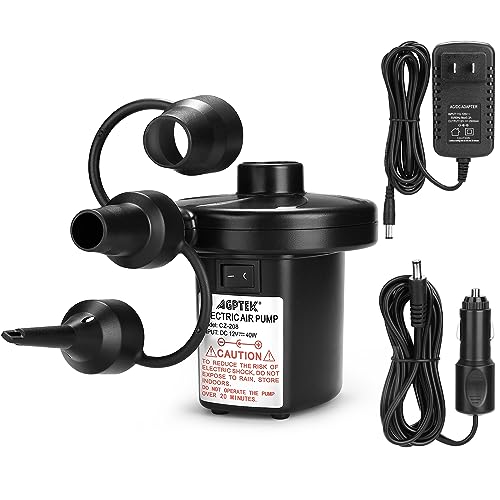
AGPTEK offers a powerful dual-power setup (car adapter and home adaptor) with three nozzle options. It inflates and deflates quickly but is explicitly not recommended for balloons. It’s suitable for outdoor use, camping, and inflating air mattresses and boats, especially where indoor power isn’t available. A limitation: not rechargeable, relies on external power sources.
Buying Guide: How to Choose The Right Inflator For Floaties
Consider where and how you’ll use an air pump for floaties. The most important factors include power source, nozzle compatibility, inflation speed, noise, and portability. If you camp or travel, a battery-powered model may be preferable. For home use, a wall-powered pump can deliver steady performance with minimal setup.
- Power Source: Do you need AC, DC, or a rechargeable battery? Battery models are best for outdoor use, while AC/DC pumps suit home or vehicle setups.
- Nozzle Variety: Are the included nozzle sizes compatible with your inflatables’ valves? Three-nozzle sets provide flexibility for most items.
- Inflation Speed: Look for PSI ratings and airflow (CFM or L/min). Higher values inflate quickly but may be louder or heavier.
- Deflation Capability: A pump with efficient deflation saves time for storage. Check if the device can both inflate and deflate with ease.
- Portability: If you’ll carry it on trips, consider weight, size, and one-handed operation. Ultra-portable models are convenient for backpacks and beach bags.
- Durability and Noise: Durable housings and thermal design reduce overheating. A lower noise level improves comfort in shared spaces.
How To Use A Portable Inflator Safely
Connect the appropriate nozzle, select the correct power source, and switch on. For deflation, place the nozzle in the valve’s venting area and activate deflation. Avoid over-inflating by monitoring the recommended inflation level for each item.
When To Choose Battery-Powered Over AC Models
Battery-powered pumps are ideal for camping, beach trips, or locations without reliable electrical outlets. AC-powered units typically offer more consistent performance for frequent home use and larger inflatables.
Maintenance And Longevity Tips
Keep air vents clear, use the correct nozzle, avoid overworking the motor, and allow cooling time after extended use. Store in a dry, cool place to maximize battery life for rechargeable models.
Practical Quick-Comparison
- Best for frequent travel: HYVOHEX or FLEXTAILGEAR for compact size and rechargeable power.
- Best for household shared inflatables: Motorenbau or Newpol for versatility and multiple power options.
- Best for fast inflation: ETENWOLF AIR 3 for rapid inflation/deflation and strong battery life.
FAQ
- Is a rechargeable pump better for floaties than a wall-powered one? It depends on where you plan to inflate. Rechargeables are better for outdoor use; wall-powered pumps are convenient at home.
- Can these pumps inflate larger items like air mattresses quickly? Yes, especially models with higher airflow and dual power options, but watch for devices not rated for high-pressure items.
- Do all pumps come with multiple nozzles? Most listed models include 3 nozzle sizes, but it’s best to confirm on the product page.
- Are these pumps suitable for inflating balloons? Many models are not designed for balloons; follow manufacturer guidance to avoid damage.
- What’s the typical inflating time for a standard pool float? It varies by model, but high-output units can inflate a float in under a minute or two under typical conditions.
- Do any pumps support deflation only? Most are inflator/deflator combos; specific deflation-only devices are less common in the consumer range.