Best BMX Bikes for 12 Year Olds: Safe, Fun Picks for Young Riders
The best BMX bikes for 12-year-olds balance age-appropriate wheel size, sturdy frames, and forgiving handling. This guide highlights five reliable options that suit beginners through intermediate riders. Each product is chosen for durability, ease of learning, and growth potential as kids develop tricks or ride preference. Ideal buyers include parents seeking long-lasting first freestyle bikes, older tweens moving from beginner parks to more advanced terrain, and gift buyers planning for a rider ready to progress. Below is a quick summary table to compare key details at a glance.
| Product | Wheel Size | Best For |
|---|---|---|
| WEIZE Freestyle BMX Bike (20″) | 20 inch | Beginner to mid-level riders seeking a full freestyle setup |
| KORIMEFA Freestyle BMX Bike (18″/20″) | 18″ or 20″ | Growing riders who want a budget-friendly start with room to upgrade |
| WEIZE Kids BMX Style (20″) | 20 inch | Youth riders needing dual brakes and stable daily riding |
| vollsch Freestyle BMX (18″) | 18 inch | Youth riders focused on basic freestyle while maintaining control |
| JOYSTAR Gemsbok 24″ BMX (24″) | 24 inch | Ages 8–12 seeking a larger wheel for stability and longer growth |
WEIZE Freestyle BMX Bike, 20 Inch

Best for: beginners and riders new to freestyle who want a complete trick-ready setup. This bike features a high-carbon steel frame designed for urban, park, or dirt riding, 170mm forged cranks, and a 32T chainring with a 16T freewheel for straightforward pedaling. The wide 20×2.40” tires offer grip and impact absorption on uneven surfaces.
Why selected: the single-speed drivetrain reduces maintenance and gear-management, making it easier for new riders to focus on balance and technique. The 360-degree rotor supports basic bar spins—an entry point to freestyle riding. A potential limitation is the absence of adjustable brakes or gears, which means the bike emphasizes steadier handling over advanced gear options.
KORIMEFA Freestyle BMX Bike 18″/20″
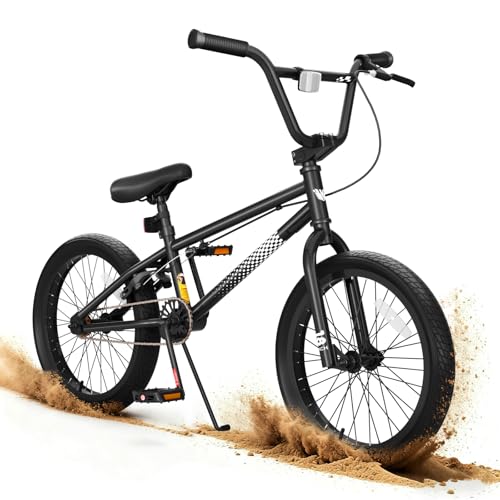
Best for: growing riders who need a bike that adapts from 18″ to 20″ as they mature. This model offers a heavy-duty hi-ten steel frame built for street, park, and dirt tricks, with a simple rear caliper brake and no gyro in the base setup—good for beginners who will upgrade as they gain confidence.
Why selected: it’s a flexible starter that matches skill progression without overwhelming new riders with complex parts. Caution: the base configuration does not include pegs or a gyro, which limits some freestyle options until upgrades are added.
WEIZE Kids BMX Style Bike, 20 Inch

Best for: young riders who want dual braking and a protective design for school routes and local parks. Features include dual hand and foot braking for easy stops and a fully enclosed chain guard to prevent clothing from catching in the chain. The bike also comes with front and rear fenders to help keep clothes clean during rides.
Why selected: this model emphasizes safety and maintenance ease, with removable training wheels often a plus for beginners. Limitation: some riders may outgrow the 20″ wheel as height increases, needing a larger frame later.
vollsch Freestyle BMX Bike 18 Inch

Best for: younger riders starting freestyle with a compact frame that’s easy to control. The 18.2-inch top tube provides stability, and the 32T chainring with a 140mm crank helps maintain smooth pedaling. It uses an aluminum rear U-brake and hand lever for precise speed control.
Why selected: its smaller size is ideal for early teens or pre-teens who still benefit from a forgiving geometry. Caution: because it’s 18″, it may be less comfortable for taller riders approaching the 5′ height threshold.
JOYSTAR Gemsbok 24″ BMX Bike

Best for: riders aged 8–12 seeking a larger wheel that improves stability and momentum on streets and parks. The Gemsbok features dual hand brakes, a simple single-speed setup, and a durable hi-ten steel frame designed for growth and confidence.
Why selected: the 24″ wheel helps older kids maintain speed with less effort while learning. Limitation: more weight and larger frame may be less suitable for shorter riders or those still mastering basic balance.
Buying Guide
Key purchase considerations include wheel size alignment with rider height, frame durability, and braking setup. For new riders, a bike with a simple single-speed drivetrain and dual handbrakes often reduces learning friction. If the rider plans to try more advanced tricks, look for a model with a robust freestyle-focused frame, a reliable rotor, and the possibility to add pegs or a gyro later.
Questions to guide selection:
- What is the rider’s current height and comfort with balance on a 20″ vs 24″ wheel?
- Does the bike offer safety features such as chain guards, fenders, and dual braking?
- Will the rider soon outgrow the wheel size, and is the bike adaptable to that growth?
- Are upgrade paths available if the rider progresses to advanced tricks?
FAQ
- What wheel size is best for a 12-year-old? A: 18″ to 24″ wheels are common; choose based on rider height, comfort, and growth plans.
- Is a single-speed BMX good for beginners? A: Yes, it simplifies learning and reduces maintenance, but check if dual braking is available for safety.
- Should I choose a 20″ or 24″ BMX for a growing rider? A: Start with 20″ if height is within average range; consider 24″ if the rider is taller or prefers stability at speed.
- Are pegs and gyros necessary? A: Not for beginners; they’re optional upgrades as skills advance.
- What safety features matter most? A: Durable frame, reliable brakes, chain guard, and protective fenders help reduce risk during early riding.