Best Canoe Trailer for Bike: Top Picks for Safe, Stable Hauling
Answering the search for a reliable canoe trailer that doubles as a bike trailer, these picks emphasize stability, load capacity, and ease of use. Ideal buyers include outdoor enthusiasts who need to transport kayaks or canoes to launch sites, weekend campers looking to bring gear, and bike-touting families seeking versatile gear-hauling options. The table below compares five strong choices to help you decide quickly.
| Product | Best For | Why It Stands Out |
|---|---|---|
| Rambo Canoe and Kayak Trailer Cart | Heavy-duty hauling with extendable reach | High capacity, padded contact points, extendable frame |
| VEVOR Bike Cargo Trailer (160 lbs) | Compact, durable daily use | Balanced steel frame, 16″ wheels, easy storage |
| Malone MPG461KB MicroSport 2 | Multi-kayak and bike-capable | Two J-Rack carriers, spare tire included |
| Malone MPG441KB-BLK MicroSport Off-Road | Rugged trails and off-road use | Off-road design, integrated spare tire |
| Burley COHO XC | Single-track and narrow trails | Coil-spring suspension, quick-release hitch |
Note: Each product is optimized for transporting watercraft or gear behind a bike or as a standalone cart. Consider wheel type, load capacity, and terrain handling when selecting the best trailer for your setup and climate.
Rambo Canoe and Kayak Trailer Cart

The Rambo trailer offers a heavy-duty build with an extendable frame that reaches up to 10 feet, making it suitable for long transfer routes from parking to launch sites. It supports up to 300 lbs when used as a hand cart and includes padded contact points to prevent dents or scratches on hulls. Best for: canoe or kayak owners who frequently move watercraft over varied terrain and need a robust, adjustable solution. Caution: assembly requires attention to the included guide for a secure setup, especially on longer extensions.
VEVOR Bike Cargo Trailer (160 lbs)

This trailer delivers a practical balance of capacity and portability. It handles up to 160 lbs, features a steel frame with powder coating for rust resistance, and uses 16″ tires with iron hubs for stability on mixed surfaces. Best for: those who want a durable daily-use trailer that folds into storage and pairs well with most standard bike wheels. Limitation: 160 lbs may be limiting for larger watercraft or heavy gear sets.
Malone MPG461KB MicroSport 2

The MicroSport 2 trailer is designed for multiple watercraft and bikes, featuring two J-Rack kayak carriers and two bike racks plus a spare tire. It’s built for larger voyages with an 800 lb capacity across the trailer, making it a capable choice for families or clubs. Best for: users who frequently transport two kayaks and bike gear. Caution: assembly and rack configuration may require careful setup to ensure load balance for longer trips.
Malone MPG441KB-BLK MicroSport Off-Road
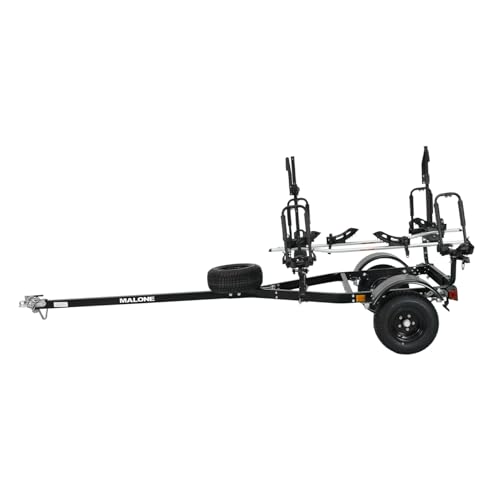
The Off-Road MicroSport adds rugged features for rougher terrain, including a spare tire and a 800 lb capacity. The 65″ curved tray-style bike rack is designed to accommodate larger gear and offers stability on uneven paths. Best for: adventurers who need a trailer capable of handling rocky trails and mud while carrying two kayaks or bikes. Limitation: heavier build may require stronger towing equipment on some bikes.
Burley COHO XC Single-Wheel Trailer

The Burley COHO XC uses a single-wheel design with coil-spring suspension, providing a slimmer profile and smoother rides on narrow trails. Its height-adjustable kickstand aids loading and unloading, and the quick-release hitch connection simplifies setup. Best for: cyclists who ride single-track or narrow trails and want a lighter, more maneuverable trailer. Caution: single-wheel design can be less stable with large, uneven loads compared to dual-wheel trailers.
Buying Guide
Key considerations help tailor a trailer to your needs:
- Load capacity: Match the trailer’s weight limit to your typical gear, watercraft, and whether you’ll carry extra supplies on long trips.
- Wheel design: Dual wheels improve stability and cargo security on uneven terrain; single wheels save weight and space but can be less forgiving on rough surfaces.
- Wheel size and tires: Larger tires provide better clearance on dirt or sand; tread and puncture resistance affect longevity in rugged environments.
- Frame material and finish: Powder-coated steel offers rust resistance; galvanized steel resists corrosion in marine settings.
- Attachment options: Universal hitch compatibility and ease of detachment influence setup time and versatility with different bikes.
- Rack configurations: Some trailers support multiple watercraft with integrated bike racks, while others emphasize one purpose; assess your primary use case.
- Storage considerations: Foldable or compact designs help when storing the trailer in a garage or apartment.
Practical questions
- What’s the best trailer for two kayaks or a kayak and bike combo? Look for trailers with dual racks or dedicated watercraft carriers and robust load capacity.
- How important are padded contact points? They protect hulls from dents and scratches, especially on longer hauls.
- Is a spare tire necessary? A trailer with a spare reduces downtime in remote locations.
- Do I need off-road capabilities? If trails lead to launch sites through soft ground or gravel, an off-road trailer offers better stability.
- How does extended length affect towing? Longer, extendable frames provide reach for distant launch points but add complexity; ensure compatibility with your bike and parking space.
- Are these trailers easy to assemble? Most include guides and simple hardware, but setup clarity and included tools influence initial use.
FAQ
- Q: Can these trailers be used with ordinary bicycles? A: Yes, most use standard hitch interfaces, but verify hitch compatibility with your bike model.
- Q: What kind of maintenance is required? A: Keep metal parts dry after use, inspect straps and buckles, and periodically check fasteners for tightness.
- Q: Are these trailers good for saltwater use? A: Trailers with rust-resistant finishes (powder-coated or galvanized steel) perform better in marine environments.
- Q: How do I secure a canoe or kayak? A: Use included ratchet straps and buckles to secure the hull, ensuring no movement during transport.
- Q: Can I transport bikes simultaneously? A: Some models feature integrated bike racks; verify the rack configuration supports your bike types and sizes.