Best Decline Benches for Abs: Top Picks for Home Gyms and Core Power
Answering the common question, which decline bench is best for abs, these options emphasize stability, comfortable support, and effective decline positioning for core-focused workouts. Ideal buyers include compact home gym users, tall individuals needing longer backrests, and athletes prioritizing heavy-duty benches for decline sit-ups and presses. Below are five strong contenders with clear strengths and practical trade-offs to help you choose.
| Product | Who It’s Best For |
|---|---|
| Finer Form Gym-Quality Adjustable Sit Up Ab Bench | Home gym users seeking high weight capacity and tall-user comfort |
| BODYWAKER Semi-Commercial Sit-Up Bench | Heavy-duty home workouts needing robust support |
| Finer Form Sit Up Bench With Reverse Crunch Handle | Versatile ab bench for varied decline and flat positions |
| YOLEO Adjustable Weight Bench | Users needing many incline/decline angles with quick setup |
| BODY RHYTHM Professional Sit-Up Bench | Tall users needing longer backboard and adjustable heights |
Finer Form Gym-Quality Adjustable Sit Up Ab Bench
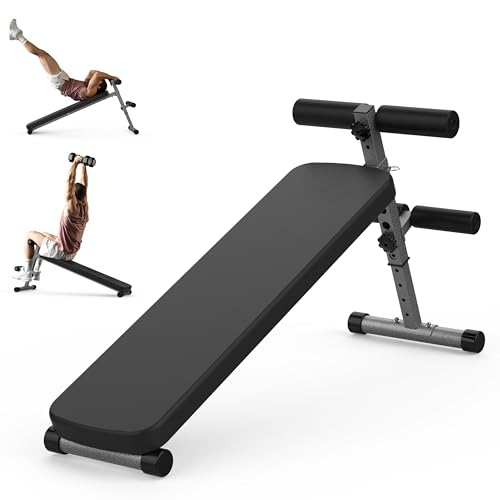
Best for buyers needing high stability and a long backrest for tall users. This bench supports up to 660 lbs and features an extended backrest suitable for users up to 6’2″. It excels as a decline bench for weighted sit-ups and can double as a platform for decline presses, delivering full-body support. The heavy-duty steel frame minimizes wobble during intense sets.
Limitations to note: the generous size may occupy more floor space, and users shorter than average might find some positions less compact.
BODYWAKER Semi-Commercial Sit-Up Bench

Best for buyers needing a heavy-duty, high-capacity bench with multiple height options. This bench supports up to 800 pounds and includes an adjustable foot roller for a personalized fit. The extended backboard adds comfort for taller users, making longer sets and heavy core work more sustainable.
Caution: very tall or wide users may still require extra floor space; ensure your setup accommodates its footprint.
Finer Form Sit Up Bench With Reverse Crunch Handle

Best for buyers seeking a versatile 2-in-1 decline and flat bench design. It features a 1100 lb weight capacity via a heavy-duty steel frame, plus an adjustable foot roller to fit different heights. The reversible crunch handle helps target lower abs and obliques, expanding exercise options beyond standard sit-ups.
Limitation to consider: while very capable, some users may prefer a model with a broader base for extra stability in dynamic movements.
YOLEO Adjustable Weight Bench

Best for buyers who want a bench with many incline and decline positions plus quick setup. This bench is ASTM-certified with a high capacity and offers 84 incline/decline/flat positions. It ships mostly pre-assembled, and its ladder-lock angle adjustments support a wide range of training angles for core, chest, and leg work.
Caution: the extensive adjustability can be overwhelming for beginners; take time to set a safe starting angle.
BODY RHYTHM Sit Up Bench with Adjustable Heights

Best for buyers seeking a long-lasting semi-commercial sit-up bench with multiple height positions and a reverse crunch handle. It features a curved backboard designed for comfort and better leverage during decline crunches. Suitable for a range of core exercises and decline presses.
Limitation to consider: taller users should verify backboard length to ensure full comfort during extended workouts.
Buying Guide
Key purchase considerations include stability, weight capacity, backrest length, and adjustability range. Choose a bench with a wide, sturdy base for stability during heavy ab work. A longer backboard suits taller users; verify height specifications before buying. For versatility, look for multi-position benches that support both decline and flat benching for full-body routines.
- Stability vs. footprint — Do you have enough space for a heavy-duty bench, and does the base design minimize wobble on your flooring?
- Weight capacity — Is the bench rated to comfortably handle your planned loads, including weighted sit-ups and presses?
- Backrest length and padding — Will the backrest accommodate your height, and is the padding sufficient for long sessions?
- Adjustability range — How many decline angles and heights are available, and how easy is it to switch between settings?
- Attachment and accessories — Does the bench include or support extras like a reverse crunch handle or leg rollers?
Frequently Asked Questions
- What is the main benefit of a decline bench for abs?
It targets the lower abs and obliques by allowing controlled decline sit-ups and crunch variations. - Should I choose a heavier-duty bench for home use?
Yes if you plan high-intensity workouts or heavy lifts; a robust frame reduces wobble during sets. - Is a longer backrest necessary for tall users?
A longer backrest provides better support and comfort for users above average height. - Can these benches be used for full-body workouts?
Many models double as flat or incline benches, enabling chest, back, and leg exercises in addition to abs work. - What maintenance is required for a metallic workout bench?
Wipe down after use, check bolts regularly, and store on a stable surface to prevent wobble. - Do any benches require assembly tools?
Some models ship nearly pre-assembled; others may require basic tools for final setup.