Best Exercise Equipment for Wheelchair Users: Accessible Helpers for Home Fitness
Finding accessible, low-impact equipment that suits wheelchair users can boost independence and daily mobility. This guide highlights five practical options designed to support arm, leg, and core strength without demanding standing balance. Each pick is chosen for ease of use, compactness, and clear benefits for rehabilitation, daily activity, or gentle conditioning. The buyer personas best served by these products include seniors seeking safer rehab, caregivers supporting home-based therapy, and individuals wanting discreet, seated workouts. The following summary table compares the core strengths of the top picks.
| Product | Best For | Key Benefit |
|---|---|---|
| CanDo Rickshaw Exerciser | Wheelchair users needing seated therapy | Accessible rehab with durable construction |
| NIdreamCE Electric Pedal Exerciser | Low-profile cardio and rehab | Motorized assisted pedaling and remote tracking |
| FITKS360 Under Desk Elliptical | Office-friendly seated or table-top workouts | Full-body options in a small footprint |
| 2026 New Upgrade Elliptical | Seniors and rehab patients | Dual-motor, low-impact arm and leg training |
| NTIUYOT Pedal Resistance Band Kit | Full-body resistance training | Strap-on resistance for multiple muscle groups |
CanDo Rickshaw Exerciser

The CanDo Rickshaw Exerciser is designed for wheelchair users and seated therapy. It enables clinical- or home-based strength training while remaining accessible for those who rely on a chair or wheelchair. The open-face design provides easy access for seated exercises, and the steel frame supports long-term use. This option is best for users who need seated, repetitive resistance with straightforward setup.
Who this is best for: wheelchair users seeking seated, functional upper- and lower-body movements without standing. Why selected: it emphasizes seated rehabilitation with durable construction for frequent use. Caution: the device is designed for seated workouts and may not substitute for standing exercise where needed.
NIdreamCE Electric Pedal Exerciser
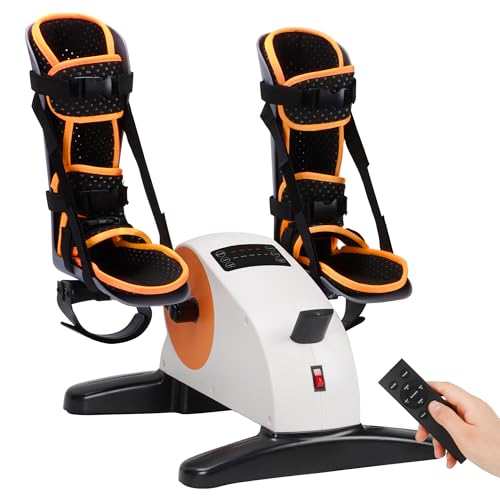
The NIdreamCE Electric Pedal Exerciser provides motor-assisted pedaling to support gentle arm and leg training. It is portable and compact, designed to tuck under a desk or sit beside seating for discreet use at home or in an office. The included remote control and LCD display help monitor time, speed, distance, and calories.
Who this is best for: seniors or individuals recovering from surgery needing guided, low-impact movement. Why selected: the 12-speed motorized assist supports progressive rehab. Caution: as a motorized device, it requires power access and regular monitoring to ensure proper operation.
FITKS360 Under Desk Elliptical

The FITKS360 under-desk elliptical offers a compact cardio option suitable for arms or legs, depending on placement. It supports full-body workouts, particularly beneficial for seniors, office workers, or individuals engaged in rehab. A four-hole strap system and non-slip pedals help keep hands and feet secure, even during longer sessions.
Who this is best for: users needing a small, stable machine that can be used seated or table-top for flexible routines. Why selected: combines portability with adjustable resistance and clear monitoring. Caution: smaller footprint may limit very vigorous training; consider user strength level when selecting resistance.
2026 New Upgrade Elliptical

This upgraded elliptical is designed for upper- and lower-body training with dual 60W motors. It offers presets and multiple speeds, enabling a customizable, low-impact routine perfect for seniors and rehabilitation. The joint-friendly motion supports increased range of motion and circulation while minimizing strain on joints.
Who this is best for: individuals seeking a motor-assisted, seated-friendly cardio option for both arms and legs. Why selected: dual-motor design enables independent or combined training, increasing rehab flexibility. Caution: low-impact machines may still challenge users with limited mobility—start at the lowest speed to gauge tolerance.
NTIUYOT Pedal Resistance Band Kit

The NTIUYOT resistance band kit provides upgraded, thickened latex tubes and soft-foot pedals. The design emphasizes higher tension and a reduced risk of breakage, suitable for comprehensive full-body workouts including abdomen, arms, back, legs, and glutes. The non-slip foot pedals add stability for seated sessions.
Who this is best for: users seeking versatile resistance training to supplement seated cardio and rehab. Why selected: stronger tension with anti-snap reliability supports progressive strength work. Caution: latex bands may require regular inspection for wear and fatigue to prevent failure during workouts.
Buying Guide: Key Considerations For Wheelchair-Accessible Fitness Equipment
- Intended use: Choose equipment that supports seated, low-impact training and does not require standing balance. Prioritize devices with gentle resistance and ergonomic handles.
- Space and portability: For home use, prefer compact designs with lightweight frames and easy storage. Under-desk options are ideal for limited space.
- Ease of use: Look for machines with simple controls, clear displays, and remote options when possible. A quick-start routine helps adherence.
- Adjustability: Seek products with adjustable resistance, multiple speeds, or foldable features to accommodate progress and comfort levels.
- Safety and comfort: Non-slip pedals, secure straps, and soft-grip handles reduce fall risk and discomfort during longer sessions.
- Durability and maintenance: Favor sturdy frames and easily replaceable parts. Regular inspection of bands, cords, and moving parts extends usability.
- Rehabilitation alignment: For rehab goals, prioritize devices designed for gentle range-of-motion improvements and motorized assistance as needed.
Frequently Asked Questions
- What equipment is best for wheelchair users starting an at-home fitness routine?
– Start with a seated, low-impact device like a pedal exerciser or resistance band kit, then add a motor-assisted option if progressive rehab is needed. - Can these devices replace physical therapy?
– They can support therapy goals but should not substitute professional medical guidance for serious conditions. - Are motorized pedalers safe for daily use?
– Yes, when used per manufacturer guidelines and with appropriate supervision or caregiver oversight if needed. - How do I choose the right resistance level?
– Begin with the lowest setting, monitor effort and form, and gradually increase as strength improves. - Is under-desk equipment suitable for all wheelchair users?
– It suits many users, but consider wheel and desk dimensions, as well as personal comfort and range of motion. - What maintenance should I perform regularly?
– Inspect bands for wear, check pedal grips, lubricate moving parts as directed, and replace cables or straps when worn.