Best Floating Waterproof Bag for Kayaking: Durable Dry Bags for Water Adventures
Answering the question most kayakers ask: which floating waterproof bag best protects gear on the water? This guide highlights five top picks that balance buoyancy, durability, and practical features for paddlers. The best choices are suited for different scenarios—from light day trips to multi-hour excursions. Use this quick reference to compare who each bag is best for and why. Whether you’re chasing a dry phone, a camera, or spare clothes, these bags help keep valuables safe while you ride the waves.
Summary table of selected products:
| Product | |||
|---|---|---|---|
| HEETA Dry Bag (5L) | 5 L | Compact trips, lighter essentials | Lightweight, easy to carry, roll-top seal |
| HEETA Dry Bag (10L) | 10 L | Mid-length paddling, phones and keys | Balanced capacity and portability |
| Earth Pak Dry Bag (various) | 10–55 L options | All-around kit with included waterproof phone case | Varied sizes and comprehensive protection |
| Unigear Dry Bag (2L) | 2 L | Ultra-portable essentials, quick access | Floating and compact with robust seams |
| Piscifun Dry Bag (10L) | 10 L | Boating, fishing, and paddling | Includes waterproof phone case and easy carrying |
HEETA 5L Dry Bag With Phone Case
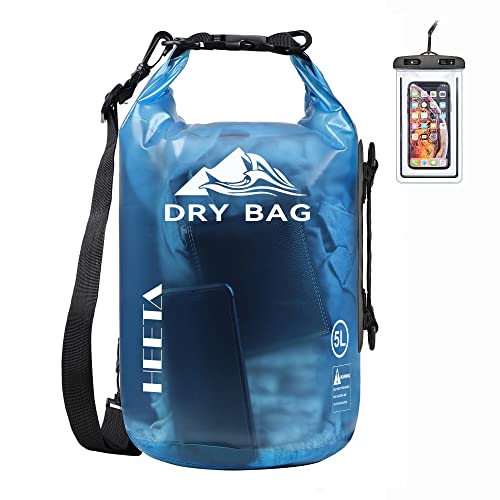
Best for: short day-trips or quick riverside expeditions where minimal gear needs dry storage. Why selected: lightweight and compact, it uses professional seamless waterproof construction with a roll-top closure to keep items dry during kayaking and water sports. The 0.6 mm bottom thickness adds durability against rocky shores. Caution: while it can handle accidental submersion, it should not be kept underwater for extended periods. This bag also features adjustable shoulder straps and a side handle for versatile carrying, making it easy to switch between handheld and backpack-style transport.
HEETA 10L Dry Bag With Phone Case
Best for: paddlers who need more space without sacrificing carry comfort on longer days. Why selected: similar construction to the 5L model with the same durable PVC material (0.6 mm bottom, 0.3 mm sides) and waterproof performance. It maintains a lightweight profile thanks to its roll-top design and can be carried as a backpack. Caution: larger size adds weight, so consider strap comfort on extended trips.
Earth Pak Waterproof Dry Bag With IPX8 Phone Case

Best for: users seeking a robust, multi-size option and an included IPX8 phone case for extra dry protection. Why selected: Earth Pak offers reliable protection with a choice of sizes (10–55 L) and a shoulder strap system for stability on rough water. The IPX8-certified waterproof phone case is included to protect devices even when fully submerged briefly. Caution: larger bags require more careful loading and balance on the kayak to avoid tipping; ensure straps are properly adjusted for heavier loads.
Unigear Dry Bag 2L Floating Kayak Bag

Best for: ultra-portable essentials and quick-access items on short paddling trips. Why selected: 100% waterproof with stiff 500D PVC and fully welded seams offer strong protection while staying buoyant. It includes an adjustable strap and an outer mesh pocket for non-dry items. Caution: capacity is limited; avoid overpacking if you need to keep items completely dry and accessible.
Piscifun 10L Dry Bag With Phone Case

Best for: versatile paddlers who want a dedicated waterproof phone case and easy access to a phone while on the water. Why selected: 500D PVC construction ensures durability, and the included touch-friendly waterproof phone case supports phone use without exposing the device to water. It also features adjustable shoulder straps and a mesh pocket for organization. Caution: ensure the seal is properly closed to maintain waterproof integrity, especially after heavy use.
Pelican 2 Pack Marine Floating Phone Pouch

Best for: travelers and water enthusiasts needing reliable phone protection during beach days and cruises. Why selected: IP68 certified floating pouch provides secure protection for phones up to 6.1 inches, with a detachable lanyard for quick access. The pouch uses a TPU design with a clear window and a secure lock mechanism. Caution: while designed for water use, avoid exposing the pouch to harsh solvents or long-term submersion beyond its rated capability.
Buying Guide
What capacity should you choose? For kayak trips that involve minimal gear, a 2–5 L bag is often sufficient. For day trips with extra layers, phones, a camera, or snacks, consider 10–20 L bags. For longer excursions or shared gear, larger sizes (30–55 L) offer more versatility but require careful loading and balance in the cockpit.
What features matter most? Look for waterproof seals, seam construction, and durable material (PVC or equivalent). A floating bag helps locate gear if it’s dropped overboard. Padded or adjustable straps improve carry comfort, especially when backpack-style carrying is used between launches. A built-in phone case adds convenience and protection for device-heavy trips.
Which design should you favor? Roll-top closures are common and effective, but zip-top models can be faster to access for quick items. For rough waters, consider a bag with reinforced seams and abrasion resistance. If you want to maximize dry storage for cameras or phones, choose models that explicitly include a waterproof case or have clear windows for easy viewing without opening the bag.
Material and maintenance considerations: 0.3–0.6 mm PVC is common for dry bags, offering a balance of durability and weight. Clean bags after use with fresh water to remove salt and sand, and air dry away from direct heat. Store rolled and dry to preserve seal integrity and longevity.
FAQ
- Are floating dry bags truly buoyant? Yes, most floating dry bags are designed to float when empty or partially filled, aiding retrieval if dropped overboard.
- Can I submerge a dry bag completely? Most are water-resistant and designed for brief submersion, but prolonged underwater exposure should be avoided unless specifically rated IPX8 or higher.
- Which capacity is best for kayaking? For short trips with essentials, 5–10 L is common. For families or longer trips, 20–40 L provides more gear space while maintaining buoyancy.
- Do dry bags protect electronics? A dry bag with a waterproof phone case adds protection, but always check IP ratings and seals before submersion.
- How should I maintain dry bag seals? Keep seals clean and dry before rolling, and ensure the bag is fully rolled and clipped per instructions to maintain waterproofing.
- Are there bags that come with built-in phone cases? Yes, several options include IPX8-rated waterproof phone cases or integrated viewing windows for easy use on the water.