Best Large Garage Gym Workout Mats for Home Fitness
If you’re setting up a garage gym, the right large workout mat is essential for joint protection, noise reduction, and stable footing. This guide highlights five top options that suit different needs—from extra-thick cushioning for high-impact cardio to expansive footprints for full-body routines. Each pick is best for a specific buyer: serious lifters, cardio and HIIT enthusiasts, yoga and mobility fans, multi-use households, and budget-conscious setups. Use the comparison table to pick the mat that fits your space and training style.
| Product | Size | Thickness | Best For |
|---|---|---|---|
| CAMBIVO Large Exercise Mat (8×6, 7mm) | 8’×6′ | 7 mm | Larger garage spaces, full-body workouts |
| HAPBEAR Extra Large Exercise Mat (7’x5′, 8mm) | 7’×5′ | 8 mm | High cushioning for joints, family workouts |
| GymCope Large Exercise Mat (multiple sizes, 7mm) | Various up to 12’×6′ | 7 mm | Versatile home gym flooring |
| Stepwaver Extra Large Exercise Mat (7’x5′, 6mm) | 7’×5′ | 6 mm | Movement-heavy routines, noise dampening |
| ProsourceFit Exercise Puzzle Mat ½-inch (48–144 sq ft total) | Configurable tiles | ½ inch | Floor protection with modular setup |
CAMBIVO Large Exercise Mat for Home Gym

Size options include 8’x6′, 7’x5′, or 6’x4′ with a 7mm high-density PVC surface. This mat is designed to stay flat on concrete, offering joint protection and reduced noise for garage workouts. It’s shoe-friendly and tear-resistant, suitable for jump rope, weights, cardio, and HIIT.
Who it’s best for: gym-goers needing a stable, thicker mat for a full garage setup. Why selected: versatile size options and durable 7mm cushioning provide ample coverage and impact absorption. Caution: heavier mats may require careful handling during setup.
HAPBEAR Extra Large Exercise Mat (7’×5’, 8mm)

With an 8mm thickness and a large 7’×5’ footprint, this mat prioritizes joint cushioning for high-impact workouts and longer sessions. Its high-density PVC surface resists tearing, and the dual anti-slip layers help keep it in place on various floor types.
Who it’s best for: athletes needing extra knee and spine protection during intense cardio or strength circuits. Why selected: generous padding combines comfort with stability. Caution: heavier mats may require assistance to move.
GymCope Large Exercise Mat (7mm, multiple sizes)

This mat comes in several sizes up to 12’×6′, all at 7mm thickness, delivering a strong balance of space and cushion. It’s described as heavy-duty, tear-resistant, and versatile for cardio, weights, and yoga, with shoe-friendly use and a stable surface on hard floors.
Who it’s best for: households seeking a scalable mat solution that can grow with training variety. Why selected: multiple size options support larger layouts without sacrificing protection. Caution: the widest sizes may require dedicated storage space.
Stepwaver Extra Large Exercise Mat (7’×5’, 6mm)
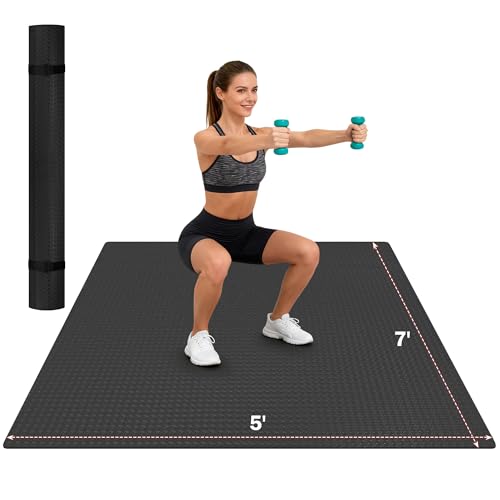
Stepwaver mats offer a 7’×5′ footprint with 6mm cushioning. They emphasize spacious movement and double-sided non-slip design to prevent slips during dynamic workouts, such as HIIT, dance, or jump rope, while dampening noise and protecting floors.
Who it’s best for: those prioritizing movement space and slip resistance. Why selected: good balance of size and thickness for versatile home gym use. Caution: 6mm thickness may be less forgiving on very hard or concrete floors during high-impact movements.
ProsourceFit Exercise Puzzle Mat ½-inch (48–144 sq ft)
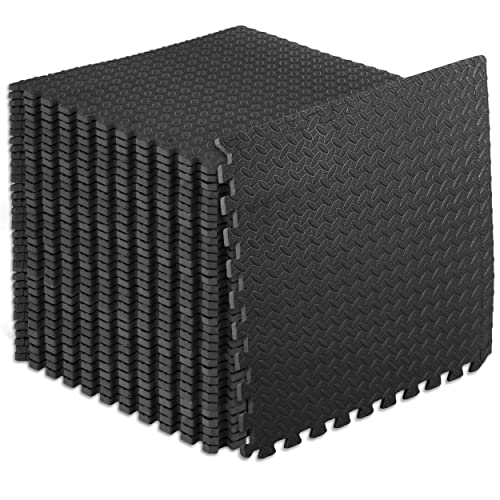
These interlocking EVA foam tiles provide a modular floor solution with ½-inch thickness, designed for protection and easy cleaning. The set ranges to accommodate large garage areas and can be reconfigured as needed. It’s a flexible option for mixed-use spaces and kids play areas.
Who it’s best for: buyers seeking a customizable layout and light-to-moderate cushioning. Why selected: modular tiles enable scalable coverage. Caution: EVA foam is less durable than PVC in very heavy-duty sessions over time.
Buying Guide
What size should you pick? For a full garage gym, aim for at least 8’×6′ to cover wide movements, with 7–8 mm thickness for joint protection. If you have tight space, 6’×4′ or 7’×5′ can still work well for circuit training. Do you prefer modular tiles or a single solid mat? Puzzle tiles offer layout flexibility and easy storage. A solid mat provides seamless protection and stability for heavier equipment.
What material matters? PVC mats tend to be more durable and tear-resistant, ideal for high-intensity and long-term use. EVA foam is lightweight and modular but may wear faster under heavy weights. Non-slip surfaces on both top and bottom help prevent shifting during jumps or sprints.
How important is noise reduction and floor protection? In a garage, a thicker mat with a cushioned surface significantly reduces impact noise and protects concrete floors from equipment and dropped weights. Look for mats marketed as joint protection and noise dampening.
Which features should you prioritize? Shoe-friendly surfaces are essential for cardio and HIIT. Anti-slip design, edge stability, and easy cleaning are practical for dust, sweat, and dirt typical of a garage gym. If you have pets or kids, consider a larger footprint to minimize movement into adjacent areas.
Frequently Asked Questions
- Do large mats fit in a small garage? Yes, choose modular or smaller footprints like 7’×5′ with 6–8 mm thickness and combine with additional mats if needed.
- Is 7 mm thick enough for heavy lifting? For most garage workouts, 7 mm provides good cushioning; consider 8 mm for extra joint protection during high-impact sessions.
- Are puzzle mats suitable for weights? Puzzle tiles protect floors but may wear faster under heavy weights; pair with a heavier-duty mat in weight-lifting zones.
- Which material lasts longer in a garage? PVC tends to be more durable and tear-resistant than EVA foam in high-use environments.
- Can I install mats over concrete with radiant heat? Yes, most PVC mats work well over concrete floors and can handle typical home-heat scenarios; check product specifics for any temperature guidelines.
- Should I buy a mat that’s shoe-friendly? Yes, if you do most workouts in shoes; non-slip layers help prevent slips during dynamic moves.