Best Monoculars for Bird Watching: Portable Optics for Birders on the Go
The best monoculars for bird watching are compact, lightweight, and weather-resistant with clear optics and a comfortable viewing experience. This guide focuses on five top picks suited for hikers, travelers, and casual to serious birders. Each option offers a balance of magnification, field of view, and rugged design to match different outdoor activities and environments.
Quick comparison
| Product | Brand | Magnification / Objective | Notable Feature |
|---|---|---|---|
| Nocs Provisions Zoom Tube 8×32 | Nocs Provisions | 8×32 | Ultra-portable; Bak4 prism; smartphone ready |
| FEEMIC 8×42 Monocular | FEEMIC | 8×42 | Wide 360 ft / 1000 yd field of view; waterproof |
| ASxmhGo 80×100 High Powered | ASxmhGo | 80×100 | High magnification with wide field; lightweight |
| OXK Optics 12×56 Monocular | OXK Optics | 12×56 | Large eyepieces; bright, sharp images |
| Pankoo 12×60 HD Monocular | Pankoo | 12×60 | Fully multi-coated; includes smartphone adapter |
Nocs Provisions Zoom Tube 8×32 Monocular

Best for ultralight backpackers and travelers who still want sharp birding views. The Zoom Tube weighs about 9.5 oz and features Fully Multi-Coated optics with a Bak4 prism for bright images at 8×32. It’s scratch-resistant, water-resistant (IPX4), and compatible with smartphone photography for quick bird snapshots. This option excels in portability and reliability in varying weather, making it ideal for walkers who prioritize weight over peak magnification. A caveat is that the compact size limits the maximum field of view compared with larger models, which can affect tracking fast-moving birds at a distance.
Best for: Lightweight hikers, casual birders, travelers needing a pocket-friendly option.
Why selected: Ultra-portable design without sacrificing bright optics; good all-around performance in diverse outdoor settings.
Limitations: Smaller objective lens means less light in low-light conditions; smartphone photography requires careful alignment for best results.
FEEMIC Monocular Telescope High Power 8×42

Best for general outdoor use where a larger objective and bright view matter. This 8×42 monocular uses a large BAK-4 prism and FMC coating to deliver high light transmittance and a bright, accurate image with a wide 360 ft / 1000 yd field of view. It’s waterproof, fog-proof, dust-proof, and shockproof, making it a reliable choice for unpredictable weather. The built-in dust cover helps protect lenses from debris. A potential limitation is that the larger size and weight of an 8×42 model can be less convenient for ultra-light trips.
Best for: Day hikes, coastal birding, and environments where weather exposure is common.
Why selected: Strong all-around optical performance and rugged build for varied outdoor conditions.
Limitations: Not as compact as ultra-light options; may feel bulkier in a compact kit.
ASxmhGo Monocular Telescope 80×100 High Powered
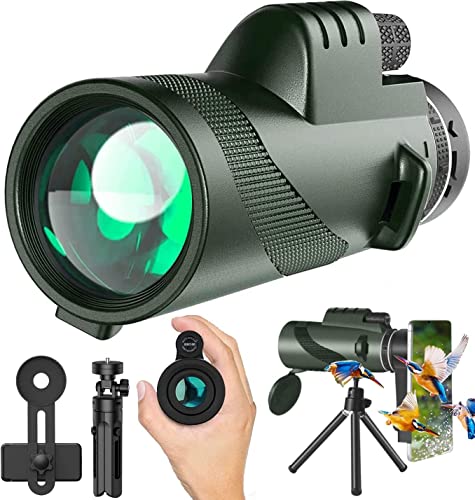
Best for birders who want powerful close-up views on distant subjects. The 80x magnification with a 100 mm objective lens provides a close perspective while maintaining a relatively wide field given the magnification. It uses a BAK-4 prism and fully multi-coated optics for high light transmission and crisp color. Lightweight, it includes a hand strap for stability. Use this if you need extreme reach for distant birds; avoid if you’re seeking handheld ease and minimal shake for long periods indoors or at shorter distances.
Best for: Long-distance birding, wildlife observation from a distance, travelers who want extreme reach.
Why selected: Excellent magnification paired with practical optics for detailed distant viewing.
Limitations: Higher magnification increases sensitivity to shake; may require a steady stance or tripod for best results.
OXK Optics 12×56 High Power Monocular

Best for birders who want a strong balance of magnification and light transmission. The 12×56 configuration uses a large BAK-4 prism with premium FMC coatings to deliver bright, high-contrast images with reduced chromatic aberration. The large eyepieces and objective lens help maintain brightness and clarity across a wide viewing angle. This model is a solid choice for those who wear glasses thanks to comfortable eyecups. Choose this if you want detailed views at moderate distances; avoid if you need ultra-wide field at high magnification for rapid bird tracking.
Best for: Birders seeking sharp detail at moderate-to-distant range with comfortable viewing.
Why selected: Strong optical quality and user comfort, suitable for extended viewing sessions.
PhysioPhyx Monocular 80×100 High Powered

Best for advanced observers who need powerful reach with solid optics. The 80x magnification paired with a 100 mm objective lens delivers a substantial zoom capability while maintaining bright, clear imagery via BAK-4 prism and fully multi-coated lenses. It’s lightweight with a rubberized body for a secure grip. Useful for long-distance birding on trails or beaches. Limitations include potential image shake at higher magnifications without a tripod or rest.
Best for: Experienced birders, field observers, travelers focused on distant subjects.
Why selected: High power combined with practical build for demanding outdoor use.
Buying Guide: What to Consider When Choosing a Bird-Watching Monocular
- Higher magnification reveals more detail but narrows the field of view and increases shake. For general birding, 8x to 12x is a versatile range; 80x or 100x are specialized for distant subjects.
- Larger lenses gather more light, improving brightness and performance in low light, but add weight and size. Common ranges are 42–60 mm.
- Bak4 prisms and fully multi-coated or FMC optics maximize light transmission and color accuracy. Coatings reduce glare and halos around birds in bright skies.
- IPX ratings and rugged builds help in rain, fog, and dust. Rubber armor can improve grip and shock resistance.
- Lightweight, compact models suit hikers and travelers. Eyeglass wearers benefit from adjustable eyecups and adequate eye relief.
- Smartphone adapters enable photo/video capture; tripods add stability for high magnification models.
Frequently Asked Questions
- What magnification is best for bird watching? A practical range is 8x to 12x for most outdoor viewing. Higher magnification is useful for distant birds but requires stability.
- Should I choose waterproof or fog-proof monoculars? Yes, if you’ll bird watch outdoors where weather can change. It helps protect optics and maintain clarity.
- Do I need a tripod for monoculars? Tripods are helpful for high-magnification models to counteract hand shake. For lower magnifications, handheld use is feasible.
- Are smartphone adapters necessary? Not required, but they are convenient for sharing captures and documenting sightings.
- What should I consider for eyeglass wearers? Look for models with longer eye relief and adjustable eyecups to prevent vignetting and discomfort.
- Which monocular is best for beginners? A lightweight 8×32 or 8×42 with good coatings and weather resistance offers a forgiving, versatile experience.