Best Outboard Motors for Kayaks: Top 5 Electric Trolling Motors for 2026
If you’re shopping for an outboard motor for a kayak, the top priority is reliable propulsion that is quiet, lightweight, and saltwater capable. This guide highlights five strong options suited for kayak anglers and casual paddlers alike. Each pick balances power, shaft length, and corrosion resistance to fit different water conditions and craft sizes. The buyers most likely to benefit are coastal or freshwater kayak users seeking hands-free steering, longer battery life, and easy depth control. A quick comparison table is provided to help you compare at a glance.
| Product | Thrust | Shaft Length | Best For |
|---|---|---|---|
| Newport Kayak Series 55lb Thrust | 55 lb | 24″ | Powerful saltwater performance for larger kayaks |
| Newport NV-Series 36lb Thrust | 36 lb | 30″ | Lightweight, portable saltwater option |
| Newport Kayak Series 36lb Thrust | 36 lb | 24″ | Compact, reliable for smaller kayaks |
| BODIOO 55lb Thrust (White) | 55 lb | 30″ | Versatile for kayaks and small fishing boats |
| Newport NK300 Electric Kayak Motor | 3HP equivalent (1300W peak) | Not specified | Long range and high efficiency for dedicated anglers |
Newport Kayak Series 55lb Thrust Transom Mounted Saltwater Electric Trolling Motor
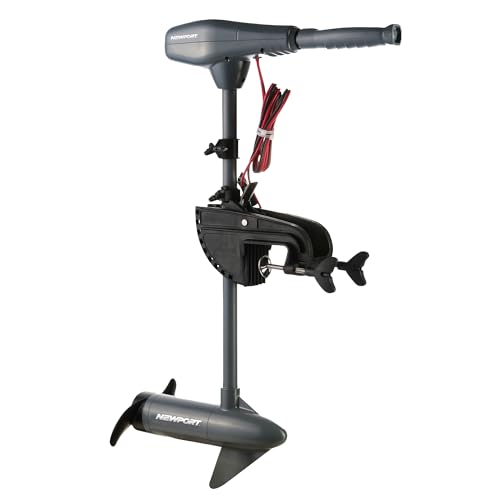
Best for: kayaks needing strong saltwater propulsion without adding excessive weight. This transom-mounted motor offers 55 pounds of thrust and a 24-inch fiberglass shaft for variable depth placement. It operates with eight speeds (five forward, three reverse) and features a six-inch telescoping handle for precise control. The motor head uses corrosion-resistant hardware suitable for saltwater use, and it runs on a lead-acid 12V battery system.
Why chosen: High thrust makes it well-suited for larger or choppier waters, while the saltwater-grade construction extends life in marine environments. The 24″ shaft supports deeper mounting for kayaks with higher freeboard, and the LED battery indicator helps monitor power without guessing.
Limitations: Heavier than some lighter paddle-friendly options; battery life will vary with load and current. Ensure your kayak transom can handle 55 lb of thrust and that mounting hardware suits your boat’s setup.
Newport NV-Series 36lb Thrust Trolling Motor

Best for: smaller vessels where weight and battery efficiency matter most. This 36-pound thrust model is designed for kayaks, canoes, inflatables, and small boats, with a 30″ shaft ideal for shallow to mid-depth mounting. It offers saltwater-ready construction and an LED battery indicator for easy runtime management.
Why chosen: Its lighter thrust is a good match for smaller craft, providing quiet operation and reliable performance in both saltwater and freshwater. The longer shaft helps you position the propeller deeper for better bite in weeds or currents.
Limitations: Not as powerful as 55 lb models, so challenging surf or strong currents may require a smaller load and calmer conditions.
Newport Kayak Series 36lb Thrust Transom Mounted Saltwater Motor
Best for: compact kayaks and anglers who want a lighter, still-water capable option. This 36 lb thrust, 24″ shaft model provides reliable control with eight speeds and a six-inch telescoping handle. It’s saltwater-rated with durable aluminum components.
Why chosen: The 24″ shaft is ideal for mid-size kayaks, and the 8-speed setup offers good control for varying water conditions. The model balances performance and weight for easy transport and mounting.
Limitations: Less thrust than the 55 lb option, so heavier loads or strong winds may require careful planning and steadier paddling assistance.
BODIOO 55lb Thrust Electric Outboard for Kayak (White)

Best for: kayaks and small fishing boats that require higher thrust with quiet operation. This model provides 55 pounds of thrust, an eight-speed system (five forward, three reverse), and a 30″ shaft with a three-blade propeller for efficiency. It uses a telescoping 6-inch handle and LED indicators for power status.
Why chosen: The 55 lb class makes it suitable for larger kayaks or heavier loads, and the 30″ shaft depth flexibility helps with weedier or deeper waters. The three-blade propeller balances thrust and efficiency for steady performance.
Limitations: The 30″ shaft adds some height to mounting; ensure your kayak transom and storage space can accommodate the setup when stowed.
Newport NK300 Electric Kayak Motor

Best for: dedicated kayak anglers seeking long-range, quiet propulsion with extended range. The NK300 delivers 1300W peak power (approximately 3HP equivalent) and is optimized for kayaks with a compact, lightweight design at about 25.5 pounds. It promises efficient operation and a wide range on a 36V system, with a maximum range up to 66 miles and up to 30 hours of run time.
Why chosen: This motor focuses on efficiency and extended runtime, making it ideal for longer trips and remote spots where recharging opportunities are limited. Its direct-drive design minimizes noise and vibration, improving stealth for fishing.
Limitations: The NK300 is specialized for kayaks; it may require a higher-capacity battery and appropriate mounting hardware for certain hull types.
Buying Guide: Key Considerations For Kayak Outboard Motors
- How much thrust do you need? Heavier kayaks or choppier water benefit from 55 lb thrust; lighter setups can make do with 30-36 lb options.
- What shaft length is right? Shorter shafts fit low-profile kayaks, while longer shafts (30″) work better on sit-on-top or higher-freeboard designs and help keep the prop away from debris.
- Saltwater vs freshwater compatibility: Saltwater-rated motors resist corrosion with aluminum and stainless components; for regular saltwater use, choose models explicitly designed for marine environments.
- Mounting and compatibility: Transom-mounted designs require a suitable transom width and mounting space; check weight limits and attachment hardware for your kayak.
- Power source and battery life: Match motor power to your battery capacity and expected trip duration. LED indicators help manage battery status during trips.
- Noise and efficiency: Quieter motors with efficient propellers conserve battery life, especially on longer excursions.
- Maintenance and durability: Look for corrosion-resistant hardware, reinforced housings, and easy-access maintenance points for long-term use.
- Ease of use: Telescoping handles, multiple forward/reverse speeds, and tilting/tower features improve control in varied conditions.
Frequently Asked Questions
- Q: Are kayak trolling motors suitable for saltwater? A: Yes, many models are designed for saltwater use with corrosion-resistant components; verify the motor is saltwater-rated before exposure to harsh marine environments.
- Q: How do I choose the right thrust for my kayak? A: For bigger or heavier kayaks, or in strong currents, aim for 55 lb thrust; smaller kayaks can often perform well with 30-36 lb thrust.
- Q: What shaft length should I pick? A: If the propeller sits too close to the waterline or weeds, a longer shaft (30″) helps; for compact hulls, a 24″ shaft is generally sufficient.
- Q: Do these motors require special batteries? A: Most kayak motors run on 12V or 24V lead-acid or lithium batteries; choose a battery that matches the motor’s voltage and your trip’s duration.
- Q: Is there a difference between transom-mounted and bow-mounted motors? A: Transom mounts are common and easy to retro-fit on many kayaks; bow mounts can offer different weight distribution and control, but may require more installation planning.
- Q: How important is a trailing propeller design? A: A three- or two-blade propeller impacts thrust, efficiency, and noise; two-blade designs typically offer efficiency, while three-blade props can deliver stronger bite in debris or vegetation.