Best Oxygen Tanks for Scuba Diving: Compact Breathing Solutions for Shallow Explores
When buying oxygen tanks for scuba diving, look for compact, safe, and reliable options that suit your diving goals. This guide highlights five practical mini tanks ideal for shallow dives, snorkeling, and emergency backup air. Best for beginners, casual snorkelers, or divers who want a portable breathing backup, these options offer clear pros, simple inflation, and aviation-grade construction where noted. The following table summarizes each pick to help you compare at a glance.
| Product | Tank Size | Best For | Approximate Run Time (Breaths/Minutes) |
|---|---|---|---|
| CHIKADIV 1L Mini Scuba Tank | 1 L | Shallow dives, beginners seeking longer breathe time | Up to ~20 minutes breathing time (depends on breath rate) |
| VEVOR 0.5L Mini Scuba Tank | 0.5 L | Snorkeling, shallow water exploration, hands-free options | 5–10 minutes |
| SMACO S300 Mini Scuba Tank | 0.5 L | Backup air, emergency scenarios, travel-friendly | ~35 breaths at 200 bar |
| GOYOJO 0.5L Mini Scuba Tank (DOT Certified) | 0.5 L | Backup air, shallow-water training, quick sessions | ~4–8 minutes depending on depth |
| SMACO 1L S400 Mini Scuba Tank | 1 L | Emergency backup, backup air for longer shallow dives | ~75 breaths at 200 bar |
CHIKADIV 1L Mini Scuba Tank

Best for divers who want longer underwater time in a compact package. The 1L capacity supports up to about 20 minutes of breathing, depending on breathing rhythm and depth. Made from aviation-grade aluminum, it resists seawater corrosion, with a food-grade silicone mouthpiece and an explosion-proof valve to prevent over-inflation. The pressure gauge helps track remaining gas. It uses an 8mm inflation interface and supports multiple inflation methods, including scuba adaptor, electric air compressor, or a hand pump as a backup.
Who it’s for: ideal for beginners seeking a longer window for shallow dives or snorkeling with a pocket-sized tank. Cautions: inflation requires careful monitoring of pressure; complete refills by professional equipment are recommended to ensure safety and consistency.
VEVOR 0.5L Mini Scuba Tank
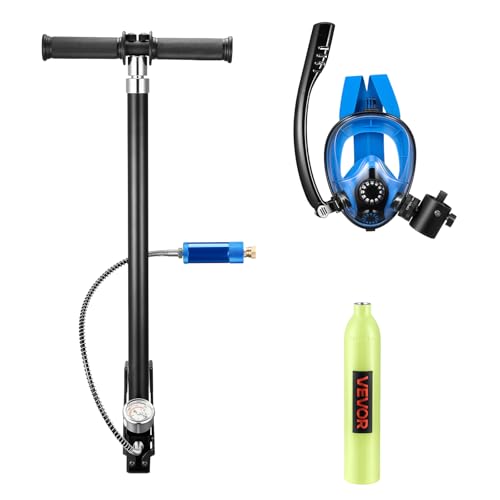
Best for snorkeling and shallow-water explorers who value a wide-view mask option and hands-free shooting. This kit includes a full-face mask and a manual high-pressure pump, delivering 5–10 minutes of breathable air at depths up to 9.8 ft. The 180° panoramic mask minimizes fogging and provides clear visibility, with a reinforced aviation-grade aluminum tank rated for 20 MPa. Choose this if you want a complete shallow-water setup in a compact form.
Caution: suitable primarily for shallow dives; do not exceed stated depth limits. The mask’s performance depends on proper fit and seal.
SMACO S300 Mini Scuba Tank 0.5L
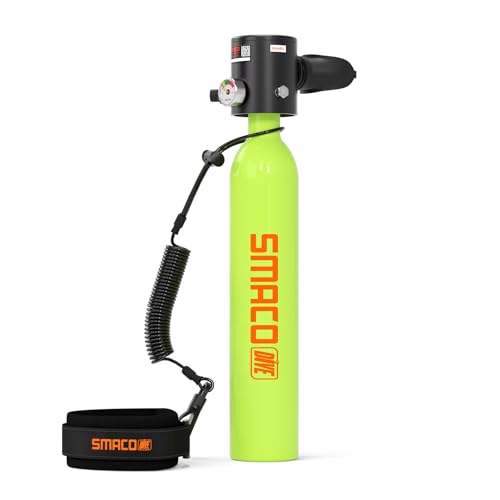
The S300 is designed with an external explosion-proof device and an upgraded valve core for smoother breaths. It delivers approximately 35 breaths at 200 bar and includes a three-layer filtration system for clean air. It is plane-friendly when disassembled, and its safe depth limit is about 16 ft, making it a practical backup air source for shallow dives or emergency use.
Best for: travelers and divers who need a lightweight backup air source that travels easily. Limitation: intended for shallow use; not a primary air supply for deep dives.
GOYOJO 0.5L Mini Scuba Tank (DOT Certified)

Best for emergency backup air with DOT certification and a durable 6061 aluminum build. The 0.5L tank provides about 4–8 minutes of air depending on depth and breathing rate, suitable for shallow-water training and quick underwater moments. It’s designed for safety in emergencies and for refilling at dive shops or with high-pressure compressors.
Choose this if you want a certified backup option that packs easily. Limitation: shorter air duration compared with larger capacity tanks.
GOYOJO 0.5L Mini Scuba Tank With Snorkel Mask

Best for an all-in-one shallow-water setup. This package combines a 0.5L tank with a full-face snorkel mask, enabling a straightforward transition from surface snorkeling to light underwater exploration. The tank is built from durable 6061 aluminum and includes a luminous pressure gauge and relief valves for safety. It supports a maximum depth around 32 feet with anti-fog mask features for clear vision.
Best for: learners who want a simple entry into underwater breathing and surface snorkeling in one kit. Caution: the depth and air duration are limited to shallow water experiences.
Buying Guide: Key Considerations For Mini Scuba Tanks
- Purpose and depth: Determine whether you want a backup air source, shallow-water exploration, or a multi-use snorkeling setup. Depth limits and air duration vary by tank size and design.
- Tank material and safety features: Look for aviation-grade aluminum construction, explosion-proof valves, and DOT certification when available. A pressure gauge helps manage remaining gas.
- Inflation options and portability: Consider how you will inflate the tank (hand pump, compressor, or scuba adaptor) and how easy it is to travel with, especially when plane-friendly disassembly features exist.
- Completeness of kit: Full-face masks or snorkel masks add convenience for surface-to-subsurface transitions. Decide if you want an all-in-one set or a standalone tank.
- Breathing comfort and breath rate: Acknowledging that individual breathing rate and depth affect air duration helps set realistic expectations for each product.
Frequently Asked Questions
- How long does a 0.5L mini scuba tank last underwater?
Answer: It varies by depth and breathing rate, typically 4–10 minutes for shallow dives at low depths, with some models offering longer duration at lighter breathing effort. - Are these tanks safe for beginners?
Answer: Yes, many models are designed for beginners and include safety features like reinforced valves and pressure gauges. Always follow manufacturer instructions and dive within your training limits. - Can I fly with a mini scuba tank?
Answer: Some models are designed to be taken on planes when disassembled. Check airline rules and ensure the tank complies with travel regulations. - What is the best option for backup air?
Answer: A compact 0.5–1 L tank with a DOT certification or explosion-proof safety features, used as a supplementary air source for emergencies or shallow-water use, is commonly recommended. - Do these tanks require professional refilling?
Answer: Refill options include professional dive shops or high-pressure air compressors. Always ensure the tank is refilled to the correct pressure specification before use. - Is a full-face mask necessary with a mini tank?
Answer: Not necessary for all users, but full-face masks can enhance visibility and safety for surface-to-subsurface transitions, particularly in snorkeling-heavy activities.