Best Pitching Machines for Catchers: Top Picks for Hitting and Fielding Practice
If you’re a catcher seeking reliable pitching machines to simulate live-game scenarios, these models offer controlled speed, varied pitch types, and portable design. The right machine helps you sharpen hand-eye coordination, reaction time, and stance consistency. This guide highlights five well-suited options for different training needs—from entry-level to more versatile setups—so you can choose what fits your practice style and budget.
Summary table of selected products:
| Product | Best For | Key Feature | Notes |
|---|---|---|---|
| Heater Slider Lite 360 | All Ages, curveball practice | 360-degree delivery with automatic ball feeder | Durable and portable |
| Heater Base Hit | Beginner to intermediate hitters | Up to 45 MPH, adjustable head | Lightweight and portable |
| PowerNet Launch F-lite | Multi-sport practice | 40-90 MPH, adjustable height/angles | Softball compatible |
| Furlihong 898BH | No-power setups, drill variety | Angle adjustable, no power needed | Durable mechanical design |
| Louisville Slugger Blue Flame | Versatile ball types | Wide pitch type compatibility | Varied speed and ball types |
Heater Slider Lite 360 Baseball Pitching Machine

The Heater Slider Lite 360 is best for players who want a flexible, all-around training tool. It delivers traditional fastballs and curveballs with a pivoting head, enabling realistic curveball batting practice. It’s ideal for catchers who need to study timing against varied pitch types. The automatic ball feeder helps maintain a steady rhythm during solo practice. A potential limitation is setup complexity compared to simpler models, which may require space and a stable surface.
Heater Base Hit Adjustable Real Baseball Pitching Machine

The Base Hit model targets players seeking authentic-feel pitching at lower speeds. With a top speed around 45 MPH and a 46-foot throwing distance, it’s well-suited for beginner-to-intermediate hitters and catchers refining swing path and contact points. Its light, portable design makes it easy to move between practice spaces. The adjustable head supports grounders and fly balls, but it may require Heater dimpled baseballs for consistent results.
PowerNet Launch F-lite Baseball & Softball Pitching Machine

The F-lite is a versatile choice for multi-sport practice, especially for teams that rotate between baseball and softball. It offers variable speed from 40 to 90 MPH and supports pitches at 25 feet with four settings. It’s best for coaches or parents who want a single unit for multiple drills, including fielding and reaction drills. A consideration is that softballs and additional accessories may be needed for full versatility, and setup can be more elaborate than single-sport units.
Furlihong 898BH Baseball Soft Toss Machine

The 898BH stands out for no-power operation, making it useful in spaces without electrical outlets. It features angle adjustments suitable for different age groups and a reliable paddle mechanism. It’s best for drills where you want a simple, low-tech setup, but the absence of electricity means you’ll need a manual rhythm. Caution: consistent timing depends on the operator’s cadence, which may vary between sessions.
Louisville Slugger Blue Flame Pitching Machine
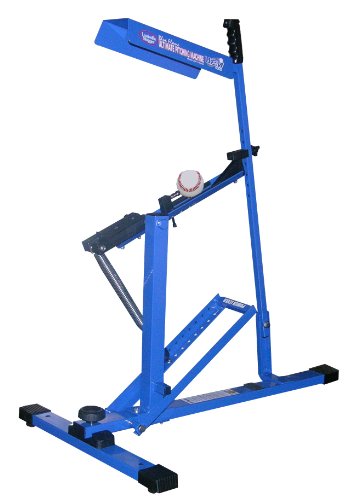
The Blue Flame is a versatile option for hitters who want to experiment with various ball types, including fastballs, softballs, dimples, and even non-traditional training balls. It offers a wide range of speeds, from slow to high, supporting precise swing mechanics from beginners to experienced players. Best for catchers who need to study timing across ball varieties; avoid if you require a compact, ultra-portable unit due to its broader pitch repertoire and setup footprint.
Buying Guide
What should you consider when choosing a pitching machine for catchers?
- Pitch variety: Do you need fastballs only, or do you want curves, sliders, and soft toss options?
- Speed range: Is a lower range ideal for beginners, or do you want high-speed pitches for advanced practice?
- Portability and setup: Will you carry the unit between fields, or train at a fixed location?
- Power requirements: Do you need a model that runs on batteries, or is a plug-in unit acceptable?
- Ball compatibility: What ball types will you use (standard baseballs, dimple balls, or softballs)?
- Automation: Is an automatic feeder or a manual feed better for your training cadence?
Quick comparisons to help you decide:
- Best for curveballs: Heater Slider Lite 360 offers a pivot head for accurate curveball delivery.
- Best for beginners: Heater Base Hit provides up to 45 MPH with easy portability.
- Best for multi-sport drills: PowerNet Launch F-lite supports baseball and softball with wide speed control.
- Best no-power option: Furlihong 898BH is ideal for manual practice without electricity.
- Best ball-type versatility: Louisville Slugger Blue Flame accepts multiple ball types for varied training.
Frequently Asked Questions
- What is the ideal speed for a catcher’s practice? Answer: Start at the lowest setting and gradually increase as you gain control and timing.
- Do I need a ball feeder? Answer: An automatic feeder helps maintain rhythm during solo practice but is not essential for all training setups.
- Can these machines simulate in-game curves? Answer: Some models, like the Heater Slider Lite 360, offer curveball delivery with a pivot head.
- Are these units suitable for soft toss drills? Answer: Several models can be adjusted for underhand or soft-toss-like feeds and high pop flies for fielding drills.
- Is portability important for practice on multiple fields? Answer: If yes, look for lightweight designs and compact footprints such as the Base Hit or Furlihong models.
- Should I buy one machine for both baseball and softball training? Answer: If you train both sports, PowerNet Launch F-lite is designed for multi-sport use with adjustable height and angles.