Best Bike Power Meters for Accurate Training and Analysis
Looking for a reliable power meter to boost cycling performance? This guide highlights five top options that balance accuracy, compatibility, and ease of use. Ideal buyers include road cyclists seeking on-bike watt data, triathletes monitoring training stress, and casual riders aiming to improve efficiency with precise feedback. Below, you’ll find quick picks, why they stand out, and who should choose each model.
Summary of selected products:
- GEOID PM500 Bike Power Meter Crankset (165mm) — Best for riders wanting high accuracy in a lightweight crank with long battery life.
- GEOID PM500 Bike Power Meter Crankset (170mm) — Best for riders needing slightly longer crank for leverage and comfort on larger frames.
- Magene PES P505/P515 Power Meter Crankset — Best for budget-conscious riders seeking reliable ±1% accuracy and rugged build.
- Magene P715 S Power Meter Pedals — Best for riders who prefer pedal-based power meters and easy installation.
- Favero Assioma Uno Power Meter Pedal — Best for plug-and-play reliability and easy maintenance with pedal-based data.
GEOID PM500 Bike Power Meter Crankset, 165mm
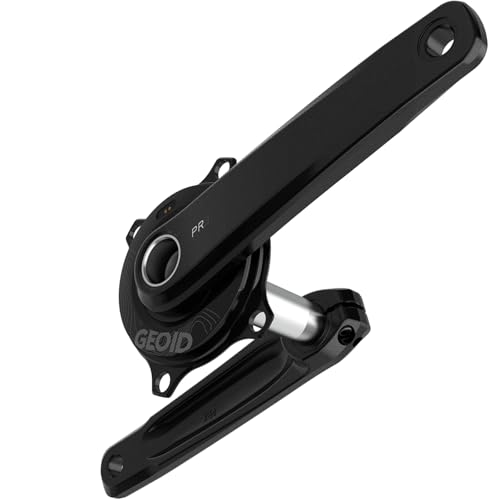
The GEOID PM500 delivers ±1.5% power accuracy using dual-sensor fusion and real-time temperature compensation. This crankset is forged from 6061 aluminum with a CNC-machined 7075 spider, delivering a total weight around 680g. It supports 110BCD and offers Bluetooth and ANT+ connectivity for syncing with training devices and apps. Battery life reaches up to 300 hours per charge with magnetic charging.
- Best for riders who want precise, stable data in a lightweight crank package.
- Best for road cyclists needing strong data transmission via Bluetooth or ANT+.
Limitation: The 165mm option may not fit every crank or frame; verify compatibility before purchase.
GEOID PM500 Bike Power Meter Crankset, 170mm
This variant mirrors the 165mm model with the same ±1.5% accuracy and long-lasting battery life. The 170mm crank offers a longer lever for riders who prefer a larger crank length. Its aluminum construction emphasizes stiffness and efficiency, suitable for performance-focused road riding. It communicates through Bluetooth and ANT+ for seamless data transfer.
- Best for riders who need a longer crank to fit large frames or specific pedal stroke preferences.
- Choose this if you want identical accuracy and battery performance in a different crank length.
Caution: Double-check crank length compatibility with your existing crankset and bottom bracket standard.
Magene P715 S Power Meter Pedals

Magene P715 S pedals offer ±1% power accuracy with a 120-hour battery life. As a pedal-based system, they provide straightforward installation and broad compatibility with ANT+ and Bluetooth-enabled devices. Pedal-based meters are often favored for their swap-ability between bikes and ease of maintenance.
- Best for riders who want quick installation and the option to move meters between bikes.
- Better for cyclists who value long battery life and precise, consistent readings.
Limitation: Some riders may prefer crank-based meters for new bike setups to avoid pedal interference with cleat compatibility.
Magene PES P505/P515 Power Meter Crankset

The Magene PES series aims for high-precision power data with ±1% accuracy, a 625g lightweight frame, and a 380-hour battery life. Built from 7075 aircraft-grade aluminum with a robust hollow-crank design, it emphasizes stiffness for aggressive riding. It integrates ANT+ and Bluetooth for broad compatibility with training platforms.
- Best for riders seeking a balance of high accuracy and a rugged frame at a competitive weight.
- Choose this if you want a lightweight crank-based meter with long battery endurance.
Caution: Data and performance can vary with temperature and riding conditions; ensure calibration is performed during setup.
Favero Assioma Uno Power Meter Pedal

The Favero Assioma Uno is a popular pedal-based power meter known for reliable data and straightforward maintenance. It emphasizes ease of installation and 50 hours of use per battery charge, with smart cycling technology to optimize pedal stroke data. ANT+ and Bluetooth compatibility enable easy syncing with training apps and devices.
- Best for riders who want a plug-and-play pedal-based solution with quick swaps between bikes.
- Better for riders who prefer a simple, maintenance-friendly power meter with consistent updates.
Limitation: Pedal-based systems may require cleat and shoe compatibility checks, and some riders notice pedal weight impact on feel when sprinting.
Buying Guide
What type of power meter should I choose?
Crankset meters provide integrated power data from the crank arms and are ideal for riders seeking a compact setup with high data fidelity. Pedal-based meters offer easy interchange between bikes and simpler installation, making them popular with multi-bike households.
How accurate is the data?
Look for products advertising ±1% to ±1.5% accuracy. These figures come from sensor fusion, temperature compensation, and calibration routines. Real-world accuracy depends on mounting, calibration, and maintenance.
What about battery life and charging?
Longer battery life reduces maintenance. Common ranges are 120–380 hours per charge depending on model and usage. Magnetic or standard charging methods vary by system.
Compatibility and connectivity?
Ensure your devices support ANT+ and Bluetooth. Some systems only connect to one app or device on Bluetooth, while ANT+ often supports multiple connections.
Installation and maintenance?
Pedal-based meters are typically easier to install and swap. Crank-based meters may require more precise torque specs and compatibility checks with bottom brackets and chainrings.
FAQ
- Q: Do I need a power meter to train effectively?
- A: Not strictly, but a power meter provides objective data to guide intensity and pacing for targeted training adaptations.
- Q: Can I use multiple power meters on one bike?
- A: Yes, but data synchronization and calibration can become complex; choose a single primary device for consistency.
- Q: Are pedal-based meters as accurate as crank-based ones?
- A: Both can be highly accurate; pedal-based meters are convenient for multi-bike setups, while crank-based units may offer slightly more stable data in some scenarios.
- Q: How often should I calibrate a power meter?
- A: Follow manufacturer guidelines; regular calibration helps maintain accuracy across temperature changes and long rides.
- Q: Will these meters affect bike weight or performance?
- A: Power meters add some weight, but most users find the performance benefits and training insights worthwhile.