Best Power Meters for Cycling: Accurate, Durable, and Easy to Use
Power meters for cycling provide precise wattage data to optimize training and performance. This guide highlights five solid options across pedal-based and crank-based designs, suitable for road and versatile riding. Best for competitive cyclists tracking left/right balance, best for riders who switch bikes often, best for riders needing long battery life, and best for MTB or gravel setups. The following selections help you choose the right fit without speculation, based on clear data points and practical buyer considerations.
| Product | Mount Type | Battery Life | Connectivity | Best For |
|---|---|---|---|---|
| Magene P715 S Power Meter Pedals | Pedals | 120h | ANT+/Bluetooth | Road cyclists needing long endurance and easy swap between bikes |
| Garmin Rally RS210 | Pedals | Rechargeable | ANT+/Bluetooth | Riders seeking dual-sensing data and quick transfer between bikes |
| GEOID PM500 Crankset 170mm | Crankset | 300h | Bluetooth & ANT+ | Road riders needing high accuracy with robust battery |
| Magene PES P505/P515 | Crank-based Power Meter | 380h | ANT+/Bluetooth | Long-distance training and endurance riders |
| Favero Assioma Uno | Pedals | 50h | ANT+/Bluetooth | Budget-conscious riders seeking single-sensor reliability |
The table above compares the five options by mount type, battery life, connectivity, and who they suit best. This helps you quickly identify which power meter aligns with your riding style, bike setup, and training goals.
Magene P715 S Power Meter Pedals

Best for endurance-focused riders who want seamless compatibility with multiple bikes and a long battery life. These pedal-based meters claim ±1% power accuracy and up to 120 hours of operation per charge. Installation is designed to be quick, enabling riders to begin data collection within minutes.
- ±1% power accuracy for reliable data across rides
- 120 hours of battery life supports long training blocks
- ANT+ and Bluetooth for compatibility with most bike computers
- Simple installation and easy transfer between bikes
Who this is best for: cyclists who switch bikes often, athletes who train long singles days, and those who want consistent data without frequent recharging. Caution: actual battery life can vary with temperature, data transmission, and sensor updates.
Garmin Rally RS210, Dual-Sensing Power Meter

Best for riders who want detailed cycling dynamics alongside power, with the added benefit of easy transfer between bikes and off-road compatibility via sensor adaptability. The RS210 uses dual-sensing for comprehensive data, including left/right balance, pedal smoothness, and power phase, delivering advanced insights in a robust package.
- Dual-sensing data for rich cycling dynamics
- Removable power sensor allows use with Rally XC210 off-road bodies
- Supports easy transfer between bikes
- High responsiveness with a modern strain gauge and gyroscope
Who this is best for: athletes who rely on precise left/right balance and power phase data, cyclists who may ride both road and off-road setups, and those who value seamless bike-to-bike transfer. Limitation: installation and removal can be slightly more involved than simpler pedal-only meters.
GEOID PM500 Crankset 170mm
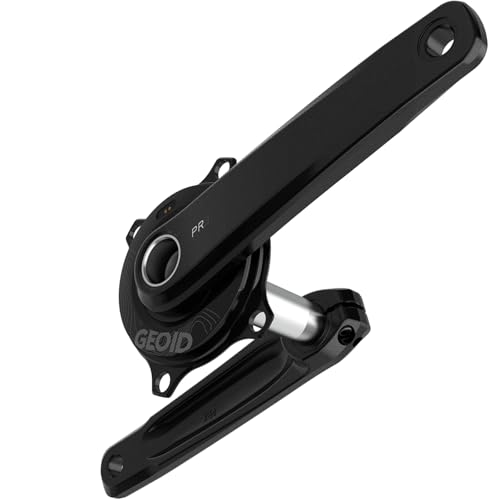
Best for riders seeking a crank-based power solution with high accuracy, extended battery life, and a lightweight profile. The PM500 integrates a dual-sensor fusion algorithm to stabilize readings under varying conditions and temperature, delivering consistent data across rides.
- ±1.5% power accuracy with temperature compensation
- 680g total weight with 170mm crank
- Up to 300 hours per charge with magnetic charging
- Bluetooth and ANT+ connectivity for broad compatibility
Who this is best for: road cyclists who want a robust, long-life crank-based meter and riders who value high stiffness and efficient power transfer. Caution: slightly higher weight than some alternatives and data precision around temperature should be monitored in extreme conditions.
Magene PES P505/P515 Power Meter Crankset

Best for riders needing a durable, high-precision crank-based system with long-lasting battery and IPX7 waterproofing. The P505/P515 line emphasizes lightweight construction and endurance-friendly performance, with a battery life that supports extended training cycles.
- ±1% accuracy from advanced strain gauges and temperature compensation
- 625g total weight with 99g spider
- Up to 380 hours of ride time
- 110BCD compatibility and IPX7 waterproofing
Who this is best for: endurance athletes and long-distance riders who want a reliable crank-based meter with strong battery life. Limitation: as a crank-based system, compatibility depends on crank and chainring arrangements across bikes.
Favero Assioma Uno Power Meter Pedal

Best for riders prioritizing easy installation and reliable single-sensor power data on a budget. The Assioma Uno provides a straightforward left-pedal power measurement setup with compatibility across most bike computers and devices via Bluetooth and ANT+. It is designed for road use with straightforward installation and swap across bikes.
- Easy installation and transfer like a normal pedal
- Automatic temperature compensation for stable readings
- Bluetooth and ANT+ connectivity
- Left-pedal single-sensor architecture
Who this is best for: riders seeking a cost-effective, simple-to-use pedal-based meter with good data quality. Caution: single-sensor design means power data is left-side only, which may matter for some biomechanics analyses.
Buying Guide: Key Purchase Considerations
How do you choose among pedal-based versus crank-based meters? Pedal-based meters are easier to swap between bikes and preserve crank compatibility, but may be sensitive to pedal placement and cleat type. Crank-based meters usually provide consistent data and can be more robust for long-term use, but may require more setup to match your drivetrain. Battery life varies widely; consider your typical training load and whether you’ll often ride multi-hour sessions. Connectivity matters too—ensure your choice works with your bike computer or smartphone ecosystem (ANT+, Bluetooth, or both). Accuracy targets range from ±1% to ±1.5%, with higher precision often correlating to more advanced sensors and temperature compensation. If you race on varied terrain, look for models with gyroscope or accelerometer enhancements for better data depth. IP ratings are relevant for riders who train in wet or muddy conditions, especially MTB and gravel riders. Finally, factor in transferability: how easily can you move the meter between bikes without tools or downtime?
Frequently Asked Questions
- What wattage accuracy should I expect from a power meter?
- Do pedal-based meters work with all bike shoes and cleats?
- How often do power meters require maintenance?
- Can I transfer a power meter between bikes?
- Which power meter is best for left/right balance data?
- Are power meters compatible with standard bike computers?
Most reputable models advertise ±1% to ±1.5% accuracy when calibrated and used under normal conditions. Real-world results may vary with temperature, installation, and calibration frequency.
Pedal-based meters are designed to work with common cleats, but you should verify cleat compatibility (SPD-SL, Look, etc.) and ensure proper installation.
Maintenance typically includes regular calibration checks and battery replacement or charging as needed. Some models offer long battery life, reducing maintenance frequency.
Yes, many pedal-based systems are designed for easy swapping between bikes, while crank-based meters may require more steps but are still designed for multi-bike use.
Dual-sensing models provide left/right distribution and balance data, while single-sensor meters focus on total power. For detailed biomechanics, choose dual-sensing options like certain Garmin Rally models.
Most power meters support common devices via ANT+ and Bluetooth. Verify compatibility with your specific bicycle computer, GPS unit, or smartphone app before purchasing.