Best Pull Down Machines for Back Strength and Full-Body Training
Answering the question for back-focused home gym buyers: these lat pulldown and high/low pulley machines are designed to target the latissimus dorsi, traps, and upper back while offering options for rows, ab work, and arm development. The list below highlights five machines that balance durability, versatility, and suitability for different space and experience levels. Best for dedicated home gym users, compact setups, or those building a complete pulling routine.
Summary table: Selected pull-down machines for back training
| Product | Best For | Key Strength |
|---|---|---|
| GDLF LAT Pull Down Machine Low Row | Intermediate users seeking solid lat work with multiple seat height options | 4-position foam rollers and adjustable seat height |
| GOIMU LS01 LAT Pulldown Machine | Home gyms needing 3-in-1 versatility (lat, row, ab crunch) | 3-in-1 pulley stations and included attachments |
| VEVOR LAT Pull Down Machine | Users wanting robust 2-in-1 system with high durability | 500 lb capacity and adjustable seat/foam rollers |
| Goimu LS01 LAT Pulldown Machine (Black) | All-around back and core work with ergonomic comfort | 3-in-1 pulley system and ergonomic seat |
| PEENHO 12-in-1 Home Gym LAT Pull Down | Versatile full-body back and arm development | Multiple pulleys and high pulley system for variety |
GDLF LAT Pull Down Machine Low Row Cable Fitness

The GDLF machine targets the latissimus dorsi with downward scapular rotation and shoulder extension. It includes four-position foam rollers to stabilize your torso and four seat-height positions to fit various users. Best for dedicated back routines and users who need precise seat and roller adjustments to minimize movement under load.
Best for: intermediate to advanced lifters who value stable setup and clear back isolation. Limitation: foam-roller adjusters may require periodic tightening for long-term stability.
GOIMU LAT Pulldown Machines, 3-in-1

GOIMU LS01 combines high and low pulleys with an AB crunch option. It ships with a lat bar, cable bar, band pegs, an ab crunch, and a tricep rope for expanded workouts. Best for home gyms needing a versatile system that can target the back, core, and arms in a single station.
Best for: users who want to switch between lat pulldowns, rows, and ab work quickly. Caution: assembly may be more complex due to multiple components.
VEVOR LAT Pull Down Machine

VEVOR offers a 2-in-1 lat pull-down and seated row with a solid 500 lbs capacity. It features a 3-level thickened seat and a four-position foam roller, supporting proper posture during long sessions. Best for users who want a rugged home gym machine with a straightforward setup.
Best for: mixed back and row work with a emphasis on stability. Limitation: high-load sessions may require checking frame bolts periodically for wobble.
GOIMU LS01 LAT Pulldown Machine (Black)
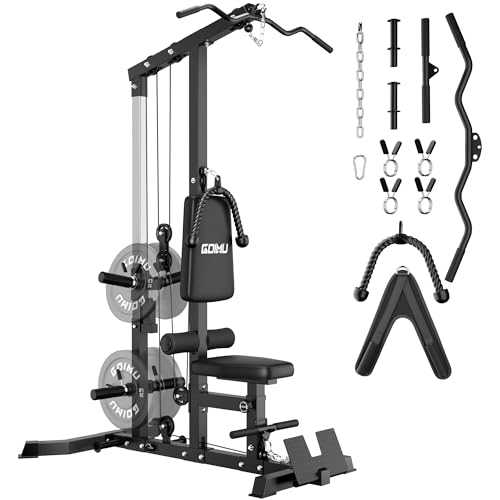
This variant of the GOIMU LS01 maintains the 3-in-1 pulley concept with ergonomic padding and adjustable height. It’s particularly suitable for households where space is limited but varied movements are desired. Best for: beginners who want an all-in-one setup with comfortable seating and clear motion paths.
Best for: users seeking ease of use and versatility. Limitation: may not support exceptionally heavy lifts as efficiently as heavier-duty commercial units.
PEENHO 12-in-1 Home Gym LAT Pull Down

The PEENHO system centers on a professional LAT pull-down with a high pulley for full-body training including back, chest, arms, and core. It emphasizes a commercial-grade frame and a high pulley layout to broaden exercise options. Best for: users looking for a comprehensive, multi-movement setup at home.
Best for: complete back and upper-body routines. Limitation: not a lightweight option; needs adequate space and solid mounting.
Buying Guide: Key Considerations For Your Back-Training Machine
- Pulley configuration: Decide between single, dual, or triple pulley stations to maximize lat work, rows, and ab crunches.
- Weight capacity: For most home gyms, aim for at least 300–500 lbs capacity to cover progressive loading without compromising stability.
- Adjustability: Look for adjustable seat height, leg supports, and foam rollers to fit different user heights and ensure proper posture.
- Attachments included: Lat bar, cable bar, ropes, and ab crunch accessories expand exercise variety and value.
- Space and footprint: Measure your workout area to ensure the unit fits and allows safe movement during exercises.
- Setup and maintenance: Favor models with sturdy frames, easy bolt-tightening schedules, and user-friendly assembly.
- Targeted training goals: If back isolation is primary, prioritize models with strong lat pulldown mechanics and full-row options.
- Ergonomics and comfort: A padded seat and well-positioned handles reduce fatigue and promote consistent form.
Frequently Asked Questions
- Q: What’s the main difference between high and low pulleys for back training?
A: High pulleys emphasize lat pulldown and overhead movements, while low pulleys support seated rows and more isolated back work. - Q: Is a 2-in-1 or 3-in-1 pulley system better for beginners?
A: A 3-in-1 system offers more exercise variety and can be more beginner-friendly as you grow, but a 2-in-1 can be simpler to set up and use. - Q: Do I need additional weights or plates?
A: Most lat pulldown machines come with weight stacks or plates; verify what is included and whether you’ll need more to meet your goals. - Q: Can these machines replace a free-weight back routine?
A: They supplement back training with controlled resistance; for maximal muscle development, combine with free weights and bodyweight exercises as part of a balanced program. - Q: How important is return-to-start tension in a lat pulldown?
A: Sufficient tension maintains control during reps and protects the shoulders, improving form and progression. - Q: Are these units suitable for small spaces?
A: Compact models exist, but most require a dedicated area for safe operation and full range of motion.