Best Paddle Board Pumps for Quick Inflation on the Water
When selecting a paddle board pump, you want reliability, precise pressure control, and enough power to inflate a board quickly. This guide highlights five top options that balance portability, performance, and ease of use. Each pump is suitable for different paddlers: casual weekend users, frequent travelers, car-camp adventurers, and those who prioritize cordless operation or vehicle power. The following summaries help you compare features and decide which model fits your routine.
| Product | Key Benefit | Best For |
|---|---|---|
| Paddle Board Pump Electric Portable, KOSMEGAL SUP Pump for Paddleboard | Auto-off at preset pressure; multiple nozzle compatibility; up to 20 PSI | Frequent inflators who want quick, controlled high-pressure inflation |
| Paddle Board Pump Electric Portable, Professional SUP Pump (Lake Blue) | One-stop technology; car-powered; 6-Nozzle versatility | Car trips and beach days; users seeking car-powered reliability |
| 12V Car-Powered Paddle Board Pump, Dual-Stage Inflator | Dual-stage for fast fill and precise high-pressure up to 20 PSI | In-vehicle inflation; time-conscious paddlers |
Paddle Board Pump Electric Portable, KOSMEGAL SUP Pump

The KOSMEGAL SUP Pump uses an efficient, single-stage design capable of inflating up to 20 PSI with automatic shutoff at the set pressure. Its intelligent display lets you choose PSI, KPa, BAR, or KG/CM², and it includes seven nozzles to cover SUPs, air mattresses, kayaks, and more. Best for paddlers who want a strong inflator with precise pressure control and a broad nozzle selection. Caution: deflation requires manual release, so plan for quick pack-down if you need rapid deflation.
Paddle Board Pump Electric Portable, Professional SUP Pump (Lake Blue)
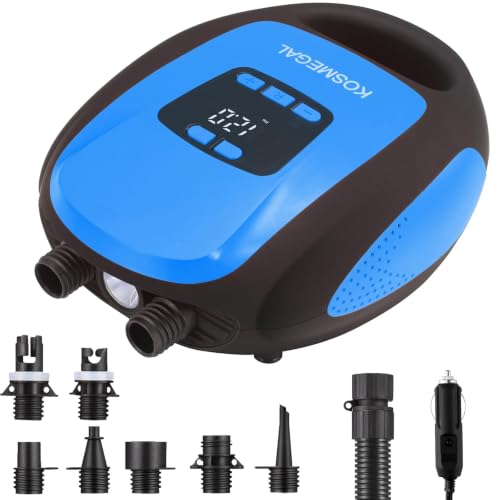
This model emphasizes car-powered operation, ideal for road trips and places without easy power outlets. It features a one-stop technology for faster inflation and six nozzles for versatility beyond SUPs. Best for travelers who frequently inflate at the car, or for those who want a semi-portable unit that remains tethered to a vehicle power source. A limitation is that it is not battery-powered, so you’ll need a running vehicle to use it.
12V Car-Powered Paddle Board Pump, Dual-Stage

This pump uses a dual-stage system to accelerate inflation while maintaining high-pressure accuracy up to 20 PSI. It is designed for users who want a robust vehicle-powered option and value fast inflation times. Best for paddlers who routinely inflate larger boards or prefer a stable power source from a vehicle. Limitation: requires continuous connection to a 12-volt car socket, with a 3 m cable for maneuverability.
Aoiiefe Paddle Board Pump, 13500mAh Rechargeable

Aoiiefe offers a cordless option with a 13,500 mAh battery, inflating up to 12 PSI in around seven minutes. Its three inflation settings and auto-off ensure safe, hands-free operation. Best for beach trips and camping where battery power is preferred over vehicle or wall outlets. Caution: battery runtime can vary with ambient temperature and usage, and charging time is several hours.
50PSI Paddle Board Electric Pump (NIUFAZU)

NIUFAZU provides a high-capacity, rechargeable option with 12V DC compatibility. It can inflate up to 12 PSI quickly and supports deflation to speed up packing. Best for multi-board venues or users who need a strong battery-powered option with long runtime. Limitation: still relies on a built-in battery, so performance can vary with battery health and charge cycles.
Buying Guide
- Power source: Choose between rechargeable cordless, vehicle-powered, or wall outlet options based on where you paddle and store your gear.
- Inflation speed vs. precision: Dual-stage systems inflate quickly at low pressure and precisely at high pressure, reducing overall pump time.
- Pressure range: Most boards require up to 12-15 PSI; select a pump that can handle at least 15-20 PSI for headroom.
- Nozzle versatility: Seven-to-eight nozzle sets accommodate SUPs, air mattresses, kayaks, and inflatables; confirm compatibility with your accessories.
- Auto-off and deflate: Auto-off at target pressure helps prevent overinflation; a deflation function speeds packing up.
- Portability: Cord length, weight, and battery capacity impact how easy a pump is to take on trips.
- Durability and safety: Look for robust housings, clear LED or LCD displays, and stable clamps or handles for transport.
Frequently Asked Questions
- What is the typical PSI needed for most SUP boards?
Most boards operate around 12 PSI, with some models tolerating up to 15 PSI or 20 PSI for stiffer performance. - Do I need a deflation function?
Deflation helps speed up packing, especially after a day on the water when you want to get back to shore quickly. - Is cordless better than car-powered?
Cordless pumps offer portability for remote locations; car-powered units are convenient when you’re near your vehicle and avoid battery concerns. - Can these pumps handle other inflatables?
Yes, most pumps include multiple nozzles and can inflate air mattresses, kayaks, tents, and boats in addition to SUPs. - How long does charging take for rechargeable models?
Recharge times vary by model, typically several hours; plan charging around your trip schedule. - Are automatic shut-off pumps reliable?
Automatic shut-off helps prevent overinflation by stopping at the preset pressure, but always verify the setting before leaving the pump unattended.