Best Gym Equipment Storage Racks for a Tidy Home Gym
Answering the common question “What rack should I use to organize my gym gear?” this guide highlights versatile, sturdy storage racks that help keep yoga mats, dumbbells, resistance bands, and accessories neatly organized. The picks below are suited for home gyms, studios, or garages and cater to different space needs. If you want mobility, look for racks with wheels; for wall space, consider wall-mounted units; and for maximum capacity, choose heavier-duty steel builds. The table summarizes the top-selected products and whom they’re best for.
| Product | Best For | Approx. Capacity |
|---|---|---|
| VOPEAK Yoga Mat Storage Rack | Small to medium home gyms; mat-centric storage | Up to 200 lbs |
| 3IngSeagulls 3 Tier Dumbbell Rack | Multi-gear storage; mobility with wheels | 65 lbs per tier (dumbbells) |
| Jusgym Multi-Functional Home Gym Storage Rack | All-in-one organization; mats, dumbbells, blocks | Up to 200 lbs |
| niffgaff Wall Mounted Home Gym Storage Rack | Maximize wall space; small floorspace | Depends on wall mounting |
| Jsiangoe LAT Pull Down Bar Storage Rack | Organize lat pulldown attachments and bands | Up to 250 lbs |
VOPEAK Yoga Mat Storage Rack
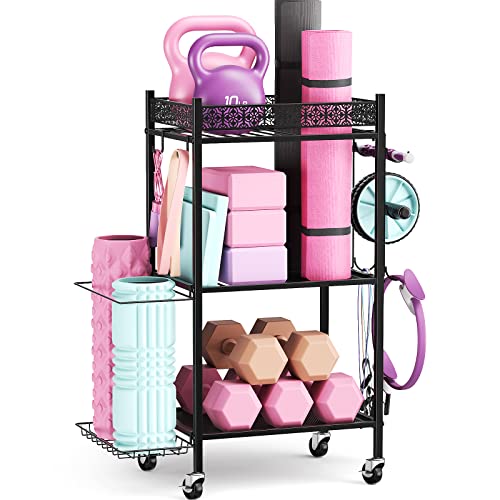
The VOPEAK rack features a 3-layer design with storage slots capable of fitting yoga mats and smaller fitness accessories. This metal rack is aimed at home gyms or studios where mats, foam rollers, and blocks need to stay organized. The construction relies on a coated metal surface to resist oxidation and water exposure, with a maximum load-bearing around 200 pounds. Best for dedicated mat storage areas and smaller equipment clusters; a practical choice when floor space is limited.
Best for: buyers prioritizing dedicated yoga mat storage with a simple, sturdy stand. Caution: if you need very large or odd-shaped items, verify slot dimensions before purchase.
3 Tier Dumbbell Rack, 3IngSeagulls

This 3-tier unit provides a large capacity workout organizer that can hold dumbbells, kettlebells, yoga mats, blocks, and resistance bands. It includes four side hooks and four moving lockable casters, enabling flexible placement and easy movement. The design aims to maximize space while offering stable weight support per tier. Best for: mixed gear storage with mobility; choose this if you want a roomy, all-in-one rack that moves smoothly between workouts.
Limitation: heavier items on wheels require regular checks to keep wheels and frames secure during movement.
Jusgym Multi-Functional Home Gym Storage Rack

This all-in-one storage solution blends three tiers for dumbbells, a side basket for yoga mats and foam rollers, and removable side hooks for resistance bands or towels. It is built from sturdy metal with a powder-coated finish, offering a weight capacity up to 200 pounds. Best for: users who want a compact, all-around rack with added hooks for accessories. Caution: ensure floor clearance for the side baskets when loading tall items.
niffgaff Wall Mounted Gym Rack

This wall-mounted unit emphasizes strong, multi-purpose storage. It is designed to hold common accessories like resistance bands, belts, jump ropes, foam rollers, and cables in one organized space. Installation is quick with included mounting hardware, making it ideal for apartments or rooms where floor space is precious. Best for: wall-constrained setups; avoid if you require freestanding storage without wall support.
Jsiangoe LAT Pull Down Bar Storage Rack

This wall-mount rack is designed to hold LAT pulldown attachments, cables, and other gym accessories, with a clearly defined rack layout. It features a rust-resistant surface and can bear up to 250 pounds when properly installed. Best for: optimizing storage for cable attachments and pulldown components; choose this if you want a dedicated home for rig-based accessories. Caution: proper mounting is critical to safety and performance.
Buying Guide: Key Considerations For Choosing A Gym Equipment Rack
- Space and layout: Decide between freestanding, mobile, or wall-mounted designs based on room dimensions and doorways.
- Weight capacity: Match the rack’s total and per-tier capacity to your heaviest items to avoid tipping or bending.
- Modularity: Look for adjustable shelves or customizable hooks to accommodate different gear sizes.
- Mobility vs. stability: Wheels help moving gear between zones; lockable casters prevent unwanted movement during workouts.
- Durability: Prefer powder-coated steel or rust-resistant finishes for longevity in humid environments.
- Accessibility: Choose layouts that keep frequently used items within easy reach to reduce rearranging.
- Installation: Wall-mounted units require proper mounting hardware and surface compatibility; freestanding racks require floor clearance planning.
FAQ: Quick Answers For Buyers
- What rack is best for a small home gym?
A compact, wall-mounted unit or a small three-tier rack optimizes space without crowding the floor. - Should I choose a rack with wheels?
Wheels improve mobility for rearranging zones; ensure lockable casters for stability during use. - Can these racks hold resistance bands and accessories?
Yes, many models include hooks, side baskets, or additional shelves for bands, ropes, and straps. - Do racks support heavy weights like kettlebells?
Capacity varies; look for higher-per-tier ratings and sturdy metal construction for heavier items. - Is installation difficult?
Wall-mounted racks require secure mounting; freestanding units are typically simpler to assemble and place. - Can I mix mats, dumbbells, and cables on one rack?
Some all-in-one racks support multiple item types, but ensure the configuration suits your gear mix and keeps items stable.