Best Range Finder for Scope: Clear Distances for Hunters and Golfers
Answering the search for a range finder tailored to scoped use, this guide highlights five practical options for long-range accuracy, quick target acquisition, and reliable performance in hunting or precision shooting. These picks cover thermal, laser, and digital-view options to suit different conditions and budgets. They’re best for hunters needing precise distance to targets, golfers seeking tournament-ready measurements, and shooters who value quick lock and stable readings in various light and weather. The table below summarizes each product’s strengths, ideal user, and notable limitations to help you decide quickly.
| Product | Best For | Key Benefit | Limitation |
|---|---|---|---|
| REVASRI Hunting Laser Rangefinder | Hunting and golf | 1000-yard range, memory mode, easy one-press scanning | Traditional laser; requires sight alignment |
| DNT Optics Zulus HD V2 | Day/Night precision | 5-20x digital scope, 60 Hz display, integrated rangefinding | Digital scope—tech-heavy, higher cost |
| GOYOJO GRS225-RF Thermal Riflescope | Thermal tracking | Thermal imaging with rangefinding and ballistic calculator | Thermal units can be price-sensitive |
| REVASRI Golf Rangefinder | Golfers and multi-sport | Slope switch, pin lock, 1000 yards, rechargeable | Slope mode legality varies by course |
| REDTIGER Golf Rangefinder | Golf course play | 1200-yard range, angle compensation, magnet mount option | Sun glare can affect LCD readability |
REVASRI Hunting Laser Rangefinder With Rechargeable Battery

Best for hunters who need reliable distance readings across open fields or woodland and for golfers who value quick target locking. This rangefinder features seven modes, including scanning and two-point height measurements. It stores the last-used mode for convenience, and continuous scan displays angle, height, horizontal, and straight-line distance. The device claims ±1 yard distance accuracy and ±1 degree angle accuracy with a 6.5x magnified view aided by multilayer-coated glass lenses and a bright LCD display, making it easier to sight targets for eyeglass wearers.
Who it’s for: hunters in broad terrain and golfers who require a versatile tool with memory and continuous scan. Why chosen: strong all-around performance with a practical feature set for field use. Cautions: performance depends on clear line-of-sight; target acquisition can slow in thick brush or heavy cover.
DNT Optics Zulus HD V2 5-20x Digital Day/Night Vision Scope

This option blends a digital day/night scope with built-in rangefinding and a ballistic calculator, designed for shooters who need high clarity in varying light conditions. The system uses a Sony STARVIS 2 sensor for sharp daytime and night imagery, paired with a bright, high-contrast display and advanced image processing. Best for: users who hunt or shoot in fluctuating light and want a consolidated scope-and-range solution. Caution: digital processing and high-brightness requires careful powering and may impact battery life in extended outings.
GOYOJO GRS225-RF Thermal Riflescope
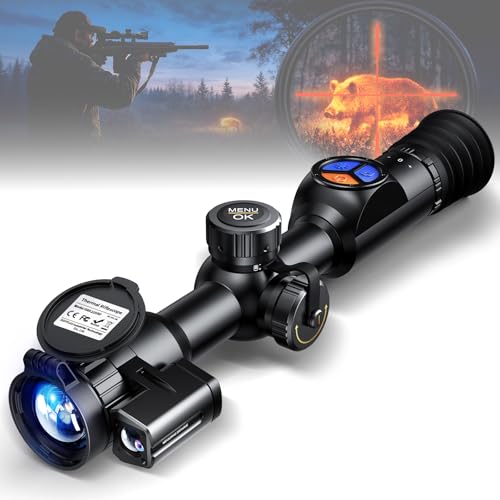
Best for hunters working in low-visibility conditions or dense brush. This thermal riflescope includes a 256×192 thermal sensor with high sensitivity, a 1440×1080 OLED display, and an integrated rangefinding tool coupled with ballistic calculations. It detects heat signatures up to 1,224 yards and provides precise holdover guidance. Cautions: thermal devices can require more battery management and may carry higher upfront costs. Choose this if your terrain reduces visible cues and you rely on heat contrast for target identification.
REVASRI Golf Rangefinder With Slope And Pin Lock

Best for golfers seeking tournament-ready features in a compact device. It includes slope compensation and a pin-lock vibration to confirm flag acquisition. The external slope switch helps ensure compliance for tournament play when slope mode is off. It offers up to 1000 yards with ±1 yard accuracy and features a built-in Li-ion battery with a low-battery indicator. Cautions: slope mode legality varies by course and competition rules; verify local requirements before use in tournaments.
REDTIGER Golf Rangefinder With Slope Switch

Best for golfers who want a robust feature set at a practical price. This rangefinder offers slope switching, golf flag-locking, and a 1200-yard maximum range with 0.5-yard accuracy, plus a USB-C rechargeable option and a transflective LCD display for better readability in sunlight. Cautions: ensure the slope feature is toggled off on legal courses to comply with rules; some users may prefer a higher brightness or glare-reduced screen in bright conditions.
Buying Guide
- Purpose and environment: Choose a model with thermal imaging for low-visibility or dense brush, or a laser rangefinder for quick, direct distance readings in open terrain.
- Range and accuracy: Prioritize units offering at least 1000 yards with sub-1-yard accuracy if precise holdover matters, especially for hunting or long-distance shooting.
- Target features: Pin-lock, flag-lock, slope compensation, and memory modes improve workflow. Ensure the feature set aligns with your activities and competition rules.
- Display and readability: Look for multilayer-coated lenses and high-brightness displays. If you wear glasses, verify the eyeglass-friendly optics and contrast.
- Power and portability: Check battery type, rechargeability, and indicator alerts. A compact form factor helps during active use in the field or on the range.
- Legal considerations: Slope functionality is legal for some courses and illegal for tournaments. Confirm local rules before use in competition settings.
- Durability and weather resistance: Seek models with robust construction and weather sealing if you hunt in varied climates or endure rain and snow.
Frequently Asked Questions
- What is a rangefinder and how does it help with a scope?
– It measures distance to a target, aiding aiming, holdover calculations, and shot selection when mounted or used with a scope. - Should I choose thermal or laser rangefinding?
– Thermal is best in low visibility for target detection; laser offers fast, direct range readings in clear line-of-sight conditions. - What does slope compensation do for golf or hunting?
– It adjusts distance to account for incline or decline, helping predict the actual shot distance. Check if slope mode complies with your rules. - How important is target lock and vibration feedback?
– Lock and vibration confirm proper acquisition, reducing guesswork in moving or distant targets. - Can I use these devices in bright daylight?
– Most rangefinders provide transflective LCDs and high-brightness displays; verify display readability under sun glare. - Do these require extensive setup or calibration?
– Most require minimal setup; some have memory modes or calibration steps for specific activities. Refer to product manuals for details.