Best Resistance Bands for Flexibility and Mobility: Top Picks for 2026
Looking to improve flexibility with safe, reliable resistance bands? This guide highlights five top options that emphasize gentle progression, skin-friendly materials, and clear progression cues. Best for beginners establishing a stretching routine, intermediate users seeking deeper ranges, and rehabilitation-focused athletes aiming to balance safety with performance.
Summary table of chosen products:
| Product | Best For | Key Benefit | Material |
|---|---|---|---|
| Lianjindun 5 Pcs Professional Resistance Bands | General flexibility | Five resistance levels, latex-free | TPE, latex-free |
| GHCTFE Resistance Bands With 12 Loops | Deep muscle relief | 12-loop fabric design, pinch-free | Polyester-Cotton blend |
| Gaiam Restore Stretch Strap | Full-body mobility | Progressive holds, 6 loops | Non-elastic strap with loops |
| WALITO Resistance Bands 3-Piece Set | Portable training | Three levels, carry-friendly | Latex-free rubber substitute |
| A AZURELIFE Long Non-Latex Bands | All-purpose rehab | Non-latex, 5 ft long | Latex-free rubber |
Lianjindun 5 Pcs Professional Resistance Bands

The Lianjindun set offers five color-coded resistance levels, ideal for gradual flexibility work and progressive stretches. Each band is latex-free, skin-friendly, and designed to maintain long-term elasticity. This makes it suitable for beginners starting a mobility routine or athletes gradually increasing stretch intensity. Best for individuals who want a simple, multi-level tool to rotate through different stretches without changing equipment.
- Best for: Beginners and fitness enthusiasts who want clear progression between light to heavier stretches.
- Why selected: Five distinct resistance levels in one set simplify building a mobility routine.
- Caution: Open-ended bands can cause snaps if overstretched beyond safe limits.
GHCTFE Resistance Bands With 12 Loops
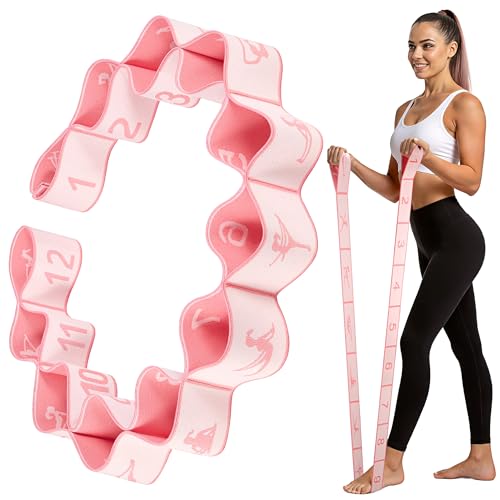
This fabric-resistance band uses 12 numbered loops to visualize progress in flexibility work. The soft polyester-cotton blend minimizes skin pinch and hair-pulling, offering a smooth, pinch-free stretch experience. Aimed at rehab and deep-range mobility, it helps users track improvements from loop 4 to loop 12 and supports safe, unassisted stretches at home.
- Best for: People pursuing measurable progress in splits, hamstring, and glute mobility.
- Why selected: Pinch-free comfort and a built-in progress tracker simplify at-home rehab and flexibility routines.
- Caution: Fabric bands may be less durable than heavy rubber options over very high-tension workouts.
Gaiam Restore Resistance Band Stretching Strap

The Gaiam Restore strap focuses on progressive stretching with six numbered loops and two stabilizing hand holds. It suits pre- and post-workout mobility work and physical therapy. This tool helps users gradually increase range of motion while maintaining safe positioning, making it ideal for those who prefer a guided stretching routine with defined milestones.
- Best for: Individuals seeking structured stretching sessions and PT-style mobility work.
- Why selected: Clear increment points help motivate and monitor ROM gains.
- Caution: Not a substitute for dynamic warm-ups that require active movement beyond static holds.
WALITO Resistance Bands 3-Piece Set

The WALITO three-piece set provides varying tension levels for flexible training at home or on the go. Made from non-latex rubber-friendly materials, these bands are a practical choice for users who want a compact, portable mobility toolkit. This set is best for those who need versatile options without bulk.
- Best for: Travelers and minimalists who want a compact mobility kit.
- Why selected: Portable, multi-level options with a focus on comfort during stretches.
- Caution: Material notes suggest avoiding repeated extreme stretches to preserve elasticity over time.
A AZURELIFE Non-Latex Resistance Bands

AZURELIFE offers long bands in non-latex composition. The three color-coded resistance levels are designed to support rehab, yoga, Pilates, and general mobility training. The 5-foot length and 6-inch width provide a stable platform for held stretches and gradual ROM improvement while avoiding latex triggers for sensitive users.
- Best for: People with latex allergies or sensitivity seeking a safe flexibility tool.
- Why selected: Non-latex construction with clear resistance levels suits rehabilitation and mobility practice.
- Caution: May be less cushioned against skin pinch than fabric options for some users.
Buying Guide: How To Choose Resistance Bands For Flexibility
- Material and skin feel: Choose latex-free bands if you have sensitivity. Fabric bands offer pinch-free comfort but may be less durable under heavy tension.
- Resistance progression: Look for sets with clearly labeled levels or loops. Progressive progression supports consistent ROM gains over time.
- Length and width: Longer bands enable deeper stretches; wider bands distribute pressure more evenly across larger muscle groups.
- Intended use: Rehab-focused options favor controlled, gentle ranges; athletic mobility tools support dynamic routines and warmer-ups.
- Portability: If travel is a factor, prefer compact sets with a carrying bag or single compact strap.
- Maintenance: Check care instructions; some fabrics resist scuffs better, while latex-free rubber may require gentler cleaning to maintain elasticity.
Practical tips for using resistance bands for flexibility
- Start with the lightest band or loop and hold each stretch for 15–30 seconds, increasing gradually.
- Focus on smooth, controlled breaths and avoid bouncing to minimize joint stress.
- Balance stretches between opposing muscle groups to maintain symmetry.
Frequently Asked Questions
- What resistance band is best for beginners focusing on flexibility?
Begin with low-resistance bands and a strap with visual progression marks to build confidence and form gradually.
- Are latex-free bands safer for sensitive skins?
Yes. Latex-free materials reduce the risk of allergic reactions while still providing adequate elasticity for mobility work.
- Can resistance bands replace a gym for flexibility training?
They can support a comprehensive mobility routine at home, but consider combining bands with dynamic movements and bodyweight stretches for best results.
- How do I prevent bands from snapping during intense stretches?
Avoid overstretching beyond the manufacturer-specified limits and inspect bands for signs of wear before use.
- Which feature helps track progress most effectively?
Integrated loops, color-coded resistance levels, or markings that denote stretch targets provide clear milestones for ROM gains.