Best Shot Timer for Dry Fire Training and Shooting Practice
If you’re building a precise dry-fire routine or preparing for IPSC/IDPA/USPSA, a reliable shot timer is essential. These devices help measure reaction times, draw speed, and split times with accuracy in any range. The top picks below cater to different training needs—from home dry-fire practice to competition-grade timing on the range. Best for serious competition prep, best for portable setups, and best for entry-level dry-fire drills.
| Product | Best For | Key Benefit |
|---|---|---|
| Shot Timer for Shooting – Design-Pie (two variants) | Advanced dry-fire and competition prep | PAR mode, 0.5–120s duration, 9-level sensitivity |
| PACT Club Timer III | Simple, reliable training timer | Ultra loud buzzer, ergonomic, readable display |
| Professional Shot Timer – Cranix | Competition-grade accuracy | 0.01s precision, ambidextrous controls |
| SG Timer GO – Shooters Global | Tech-forward training with app | Bluetooth, smart sensor, video integration |
| SPECIAL PIE Shot Timer – Competition Timer (Orange) | Ambidexterity and versatility | Six sound modes, true silent mode, LED indicators |
Shot Timer for Shooting – Design-Pie (Two Models)

This timer supports tailored personal training modes with PAR timing (0.5–120 seconds) and up to 10 repetitions. It offers four draw-delay options—instant, fixed, random, and customized—to fine-tune draw speed and follow-up shots. Best for shooters who want adjustable practice intervals and repeatable conditions during dry-fire sessions. The device uses echo filtering for accurate timing in ranges with other shooters, a must-have for public or shared facilities. Dry-fire training benefits from 9-level sensitivity, capable of detecting large-caliber shots and subtle dry-fire sounds, even finger snaps. Caution: ensure you select the correct sensitivity for your caliber and environment to avoid false triggers.
Best for: Experienced dry-fire practitioners and competition prep where precise timing and adaptable start delays matter. Why selected: Combines adjustable training modes with reliable echo-filtering accuracy and a sensitive dry-fire detection system.
Best for: Personal training at home or club ranges, especially when practicing rapid draws and follow-up shots.
PACT Club Timer III – Shot Timer

The PACT Club Timer III emphasizes a straightforward, reliable training experience. Key features include an ultra-loud buzzer, ergonomic design, and a readable display, which help you stay aware of timings during fast-paced drills. Best for shooters who want a no-fuss device that remains legible and audible in loud ranges. A potential limitation is basic functionality relative to high-end timers with advanced modes; this timer excels in clarity and ease of use rather than feature depth.
Best for: Beginners to intermediate shooters who need a dependable timer without complexity. Why selected: Easy-to-use interface and a strong audible alert make it ideal for quick, repeatable dry-fire sessions.
Best for: Entry-level practice, club ranges, and quick setup on the move.
Professional Shot Timer – Cranix
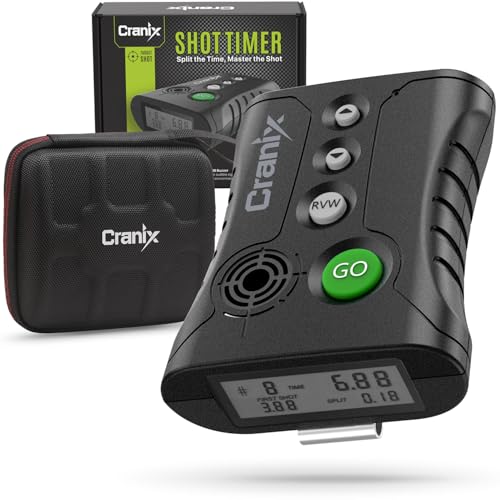
This is a competition-grade timer designed for left/right-handed use with ambidextrous recessed buttons to prevent mispresses during rapid drills. It features a sensitive side-mounted microphone for capturing every shot, even in noisy ranges, and a 0.01-second resolution for precise split and par times. A reinforced steel belt clip keeps the timer secure during stage transitions. Best for shooters who compete regularly and need precise timing and robust hardware. Caution: bulkier build may be less comfortable for pocket carry or ultra-compact setups.
Best for: Serious competitors who require high-precision timing and durable hardware. Why selected: Superior 0.01s timing accuracy and reliable signal capture in loud environments.
Best for: IPSC, IDPA, USPSA competitors who train with quick transitions and complex stages.
SG Timer GO – Shooters Global

The SG Timer GO introduces a Bluetooth-enabled training approach with a companion app for drills and performance analysis. It includes a smart sensor that detects dry-fire sounds and can filter out echoes, making it suitable for ranges with other athletes present. The belt quick release and pocket clip add portability for on-the-go practice. Best for tech-minded shooters who want video overlays and remote timer control. Limitation: app features may require a connected device and may add setup steps compared to standalone timers.
Best for: Tech-forward shooters who want integrated video and remote control. Why selected: In-range analysis and real-time video integration support advanced training workflows.
Best for: Trainers who want to capture and review drills with overlaid timer data.
Shot Timer with Belt Clip – 2026 Upgraded (Special Pie)

This model offers official timer status for competition-ready accuracy, with Bluetooth support for match apps like PractiScore 2 and IPSC ESS. It’s designed for easy single-handed operation, featuring shortcuts for walkthroughs, history data, and sensitivity/volume adjustments. The top status lights and auto-backlit display improve readability in bright sun or low-light ranges. A caution is the reliance on Bluetooth for full functionality; ensure you pair with compatible apps before practice sessions.
Best for: Competitors who rely on official scoring workflows and app integration. Why selected: Seamless match workflow compatibility and quick-access controls improve on-range performance.
Best for: Range transitions, outdoor stages, and events requiring reliable app connectivity.
Shot Timer with Belt Clip – Indesign

Indesign’s belt-clip timer emphasizes competition readiness with Bluetooth support for official scoring apps and a one-handed design for fast transitions. Shortcuts provide quick access to walkthroughs and history data, while the high-contrast display with auto-backlight ensures readability in various lighting. This timer is best for shooters who need quick operation and reliable data capture during stages. Limitation: may offer fewer advanced modes than high-end models, but excels in speed and practicality.
Best for: Practitioners who value compact design and seamless app integration. Why selected: Quick-access controls and official app compatibility streamline competition workflows.
Buying Guide: Key Considerations For Dry-Fire And Range Timers
- Timing precision: Look for timers with at least 0.01–0.5 second resolution for meaningful split times in fast drills.
- Sound and visibility: A loud buzzer, clear display, and auto-backlight improve readability in bright or indoor ranges.
- Modes and customization: PAR timing, start delays, number of repetitions, and sensitivity settings matter for varied training needs.
- Echo suppression: Effective noise-filtering ensures accurate shot detection in crowded ranges.
- Portability: Belt clips, lanyards, and pocket-friendly designs support practice on the go.
- App and data features: Bluetooth or companion apps enable video overlays, drills creation, and performance analysis.
- Durability and comfort: Recessed controls and robust build help withstand field use and rapid maneuvers.
Frequently Asked Questions
- What is the difference between a basic shot timer and a competition-grade timer?
– Basic timers provide essential timing with audible alerts, while competition-grade timers add higher timing precision, robust build, ambidextrous controls, and often official app integrations for match workflows. - Do shot timers work with dry-fire practice only?
– Many models support dry-fire detection with sensitive microphones and adjustable thresholds, making them suitable for both dry-fire and live-fire practice in controlled environments. - How important is echo filtering in a shared range?
– Echo filtering is crucial in ranges with other shooters or loud environments to avoid false triggers and ensure accurate split times. - Can timers be used with training apps?
– Some timers offer Bluetooth connectivity and companion apps to overlay timer data on videos, track progress, and share drill setups. - What should I consider when choosing a timer for IPSC/IDPA/USPSA training?
– Consider timing precision, reliability in noisy ranges, ease of use under stress, and compatibility with official scoring apps used in competitions. - Are there portable timers suitable for home use?
– Yes, several models are compact with belt clips or pocket-friendly designs for home dry-fire rooms or small practice spaces.