Best Shot Timer for Shooting: Top Timers for Training and Competition
When selecting a shot timer, the best choice depends on your discipline, range conditions, and how you train. The top picks below are chosen for accuracy, durability, and ease of use across competition formats like USPSA, IPSC, Steel Challenge, and 3-Gun. Each product is best suited for specific shooter profiles—beginner, competitive, ambidextrous use, or outdoor field training.
Buying quick reference:
- PACT Club Timer III — Best for beginners and general practice
- Cranix Professional Shot Timer (0.01s) — Best for serious competition with ambidextrous use
- PTAWO Shot Timer — Best value with clear display and simple UI
- Competition Electronics ProTimerBT — Best for data logging and multi-device use
- MOD SHOT — Best for Steel Challenge and multi-mode training
Product Comparison Summary
| Product | Best For | Key Benefit | Limitation |
|---|---|---|---|
| PACT Club Timer III | Beginner and general practice | Ultra loud buzzer, ergonomic, readable display | Limited modes compared to advanced timers |
| Cranix 0.01s Timer (Ambidex) | Competitive shooters | 0.01s precision, ambidextrous controls | Higher complexity |
| PTAWO Shot Timer | Structured practice | Clear split/total time, easy setup | Battery type not included |
| Competition Electronics ProTimerBT | Tech-savvy shooters | Bluetooth data logging and app | Requires app familiarity |
| MOD SHOT | Steel Challenge and multi-mode training | Four training modes, backlit display | Basic belt clip may vary by use |
PACT Club Timer III — Shot Timer

Features: Ultra Loud Buzzer, Ergonomic Design, Readable Display. This timer emphasizes a simple, rugged form and a loud alert to ensure signal detection in noisy ranges. Best for shooters who want a straightforward timer during regular practice or entry-level competition prep. The compact design fits on a belt or pocket for quick deployment. Caution: fewer advanced data-tracking features may limit post-drill analytics.
Cranix Professional Shot Timer (0.01s) — Ambidextrous
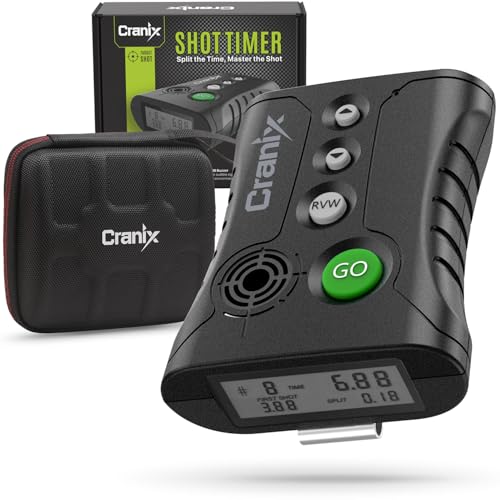
Features: Ambidextrous recessed buttons, instant 0.01s precision, side-mounted microphone, unmissable buzzer, quick-swap battery, reinforced steel belt clip. Best for competitive shooters who need precise split and par times in noisy ranges and require dependable deployment between stages. Limitation: setup and operation are more feature-rich, which may require a brief learning curve.
PTAWO Shot Timer — Professional

Features: Easy-to-use interface, tracks first shot, split, and total time; uses 9V battery (not included); clear display supports drill review. Best for shooters who want quick-start timing data and straightforward performance tracking. Caution: battery type is not included, so plan for a replacement before training.
Cranix ProTimer — Camo

Features: Left/Right-handed design, 0.01s precision, side-mounted microphone, loud buzzer, quick-swap battery, reinforced belt clip. Best for outdoor tactical courses and 3-Gun matches where fast transitions and reliability matter. Limitation: camo variant is primarily for aesthetics and field use; technical capabilities remain aligned with other Cranix models.
Competition Electronics ProTimerBT Shot Timer

Features: Bluetooth with a free mobile app, bright LED start indicator, headset jack. Best for shooters who want data cataloging, cross-device synchronization, and a private practice option when beeping needs to be muted for others. Caution: app-dependent features require a compatible device and setup.
MOD SHOT — Ultimate Shot Timer

Features: Four training modes, palm-sized and ergonomic, backlit display, belt clip, easy shot recording. Best for Steel Challenge and multi-mode training where rapid transition and quick review are valuable. Limitation: fewer data-export options compared to Bluetooth-enabled models.
Buying Guide
What should you consider when choosing a shot timer?
- Timing precision: Do you need 0.01-second resolution for exact splits, or is millisecond timing sufficient for your discipline?
- Display and readability: A backlit or bright LCD helps in outdoor ranges and with hearing protection.
- Alerts and signaling: Choose a timer with a loud buzzer or reliable microphone detection for noisy environments.
- Controls and ambidexterity: Ambidextrous or recessed controls prevent mis-taps during rapid drills.
- Durability and portability: Belt clips, compact form factor, and rugged construction matter for field use.
- Data features: Bluetooth, mobile apps, or memory for drills can support post-session analysis.
- Battery considerations: Some models require specific batteries or easy-swap designs for on-the-go use.
Frequently Asked Questions
- What is the typical timing resolution for competition timers? – Many timers offer 0.01-second precision, which supports precise split and par time measurements for professional matches.
- Do I need a timer with Bluetooth or a simple display? – Bluetooth models are helpful if you want data logging and drills tracked over time; simple displays work well for basic training.
- Is ambidextrous design important? – Yes, for shooters who frequently switch hands or practice from different positions, ambidextrous controls reduce accidental presses.
- Can a timer help with steel-challenge-style training? – Timers with multiple modes and quick-recall interfaces are beneficial for rapid draw and follow-up shot work.
- Do timers come with batteries? – Some do not; verify battery inclusion and plan for replacements before training days.
- Are mobile apps essential for shooting timers? – Apps add data tracking and review capabilities, but are not required for basic timing needs.