Best Spotting Scopes for Long-Range Shooting
Spotting scopes with strong optics and stable ergonomics help long-range shooters confirm hits, adjust holds, and study ballistics. This guide highlights five top options, explaining who each is best for and why. Whether you’re a competitive shooter, a hunter, or a wildlife observer, these picks balance magnification, light gathering, and durability to suit varied environments and budgets. Use the quick comparison table below to narrow choices, then read detailed product sections for fit and limitations.
| Product | Best For | Key Benefit |
|---|---|---|
| SVBONY SV28 (70mm) | Beginners, Budget ranges | Strong light gathering; extendable sunshade |
| SVBONY SV28 (100mm) | Longer-range observers | Brighter image in low light |
| Vortex Crossfire HD 20-60×80 | Value-focused buyers | HD optics, wide field |
| Gosky DiamondEdge 80mm 20-60x | Birders, hikers | Bright, reliable, waterproof |
| Gosky Flagship 25-75×80 | High-end entry or versatile use | Large objective, solid optics |
Buyers should prioritize: objective diameter for light capture, zoom range for versatility, weatherproofing for field use, and portability for field setups. The following sections provide concise reasoned choices based on the listed features and typical usage scenarios.
SVBONY SV28 Spotting Scope (70mm) With Tripod
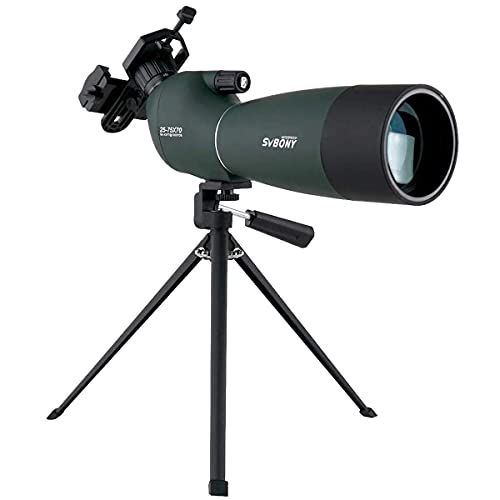
The 70mm SV28 offers 25-75x zoom with straightforward focusing, making it suitable for beginners and hobby shooters. Its 70mm objective collects ample light for better visibility at longer distances, and the extendable sunshade helps against glare. Best for entry-level long-range practice and birding in favorable conditions. Caution: low-light performance is limited compared with larger apertures, so visibility may drop at dawn or dusk.
SVBONY SV28 100mm Angled Spotting Scope

This model upgrades to a 100mm aperture, delivering more optical power and brighter views, especially in subdued light. Its 25-75x zoom remains practical for long-range shooting and wildlife observation. Best for shooters who routinely work in open fields or high-latitude lighting conditions. Limitation: heavier and bulkier than smaller scopes, requiring a sturdier tripod for stability.
Vortex Crossfire HD Spotting Scope (20-60×80 Angled)

Vortex Crossfire HD focuses on value without sacrificing essential performance. The 20-60x magnification and 80mm objective provide a balanced blend of brightness and detail, with an Arca-Swiss compatible foot for quick tripod setup. Best for shooters who want reliable performance at a reasonable price. Caution: structure may feel less premium than higher-end models.
Gosky DiamondEdge 80mm 20-60x Spotting Scope

This Gosky option uses an 80mm fully multi-coated lens and BAK4 optics to deliver bright, sharp images with good edge-to-edge clarity. Its waterproof and fog-proof construction supports field use in varied weather. Best for mid-range budgets needing robust optics and a rugged build. Limitation: higher magnification requires careful stabilization to avoid shake on rough terrain.
Gosky Flagship 25-75×80 Spotting Scope

The Flagship model offers 25-75x magnification with an 80mm objective and FMC optics, tuned for bright images and strong light transmission. It’s positioned as a high-end entry, suitable for enthusiasts who need versatility for birding and target shooting. Best for users who value wide viewing flexibility and durable, weather-ready design. Caution: it may be heavier than compact travel scopes and require a sturdy tripod for full benefit at higher magnification.
Buying Guide
What magnification range do I need?
For long-range shooting, a range of 20-60x or 25-75x covers both locating distant targets and inspecting hits. Higher-end models with 80mm objectives typically yield brighter images in low light, while lower magnification helps quicker target acquisition.
How important is objective size?
A larger objective (e.g., 80–100mm) improves light transmission and detail in low light but adds weight. Smaller lenses are lighter and more portable but may struggle in dawn or dusk conditions.
What about weather and durability?
Waterproof and fog-proof construction protects against dew, rain, and rapid temperature changes. Nitrogen fill and O-ring seals are common features in field-ready scopes.
Is a tripod compatibility and stability important?
Arca-Swiss or quick-mount feet simplify tripod setup. A stable tripod reduces image shake at higher magnifications, essential for long-range accuracy.
What about portability and ease of use?
If you travel or hike frequently, lighter models with carrying cases are advantageous. If you regularly shoot from a fixed position, weight is less critical but stability remains key.
How should I assess optics quality?
Look for multi-coated lenses, FMC or similar coatings, and the type of prisms (BAK4 is common). These features improve light transmission, reduce glare, and minimize chromatic aberration for crisper images.
Frequently Asked Questions
- What should I consider first when choosing a spotting scope for long-range shooting?
- Is a larger objective always better for long-range shooting?
- Do I need a top-tier brand to get good results?
- What accessories help with long-range use?
- How important is fog-proofing in hunting or wildlife viewing?
- Can I use these scopes for stargazing?
Prioritize objective size, magnification range, and weatherproofing to ensure reliable long-range performance in varying conditions.
Often yes for brightness, but it increases size and weight. Balance light gathering with portability for your use scenario.
Not always. Many mid-range options offer solid optics, stability, and durability suitable for most long-range tasks, with better value-per-dollar.
A stable tripod, a quality case, and a smartphone adapter for documenting shots can enhance field performance and analysis.
Very important in changing climates; fog-proof and waterproof seals maintain image clarity in wet or humid environments.
While primarily designed for terrestrial targets, some scopes can be used for basic stargazing at low magnifications, though they are not optimized for astrophotography.