Best Squat Rack for Low Ceilings: Compact Racks for Basement Gyms
Answering the common search for space-saving squat racks, this guide highlights compact options designed to fit low-ceiling basements and garages. These racks prioritize a smaller footprint while still supporting safe lifts. The best choices suit homeowners with limited vertical space, basement gym setups, or rooms with standard-height ceilings. Each featured model emphasizes stability, ease of assembly, and practical features like adjustable J-hooks and safety bars. Read on to compare five top picks, assess who they’re best for, and select a rack that maximizes workout options without crowding your space.
Buying at a glance: the table below summarizes five compact options, their standout traits, and the primary use case. Use this quick reference to narrow choices before reading full sections.
| Product | Best For | Key Benefit |
|---|---|---|
| CAP Barbell Full Cage Power Rack, 6-Foot, Green | Small home gyms needing solid fundamentals | Sturdy steel, 500 lb catches, 750 lb pull-up capacity |
| PASYOU Adjustable Squat Power Rack | Versatile home gym with high load tolerance | Adjustable height, 600 lb J-hooks, 1800 lb bumpers |
| Titan Fitness T-3 Series 73.5″ Squat Stand | Very tight spaces, single-user lifting | Short, stable, Westside hole spacing |
| FLYBIRD SR1 Squat Rack | Budget-friendly, space-conscious lifters | 22 height options, 950 lb capacity, extended safety arms |
| CAP Barbell Full Cage Power Rack, 6-Foot, White | Bright, compact option with solid build | Compact footprint, 500 lb capacity, pull-up bar |
CAP Barbell Full Cage Power Rack, 6-Foot, Green
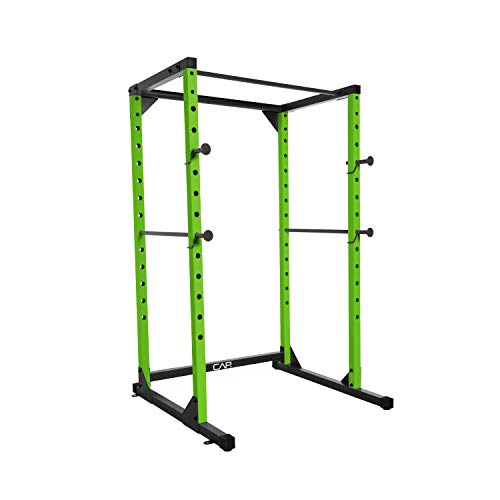
The CAP Barbell Full Cage Power Rack offers a compact footprint with a 72-inch height that makes it suitable for low ceilings. Made from 12- and 14-gauge steel tubing, it supports static weight catches up to 500 lb and a pull-up bar up to 750 lb. Gusseted uprights add stability, and integrated catches and safety bars enhance reliability during lifts. Best for beginners and intermediate lifters who want a sturdy, simple setup without a tall profile. Caution: listed weight specs pertain to components; advanced lifters may require added safety gear or a higher-capacity rack.
Who it’s best for: Small home gyms needing dependable basics without overhang. Why selected: balance of stability, safety features, and a low-height design that still accommodates squats, bench work, and pull-ups.
PASYOU Adjustable Squat Power Rack

The PASYOU SR30 rack is built from 2″ x 2″ heavy-duty steel tubing and weighs 66 lbs for stability. Factory-tested capacity reaches 1100 lbs on the J-hooks and 2645 lbs on bumpers, with a recommended working load of 600 lbs on J-hooks and 1800 lbs on bumpers. It features four reinforced safety bumpers and anti-slip pads, along with reinforced uprights and precise hole drilling for wobble-free sessions. Height is adjustable with 14 J-hook positions and 7 bumper positions, allowing use as a bench rack when paired with a bench. Best for: dedicated lifters who want broad adjustment options in a compact frame. Caution: ensure your floor can handle the combined load and verify clearance for the full height range when configured for heavier lifts.
Titan Fitness T-3 Series 73.5″ Squat Stand

The T-3 Series Short Squat Stand stands at 73.5 inches and is designed for home gyms. It delivers solid stability without floor bolting and features UHMW-padded J-hooks to protect bars during racking. Westside hole spacing improves alignment for varied lifts. Best for: basements or rooms with limited vertical clearance where a standalone stand is preferred over a full cage. Caution: check ceiling height for the top clearance when performing high-bar squats and overhead movements, as some lifts may exceed available height.
CAP Barbell Power Rack with Pull Up Bar & Attachments – Carbon

CAP Barbell’s Power Rack with Pull-Up Bar uses 11- and 12-gauge steel tubing for a compact power rack with a 46″ W x 50″ D footprint and 85″ max height. It supports up to 500 lb and includes J-cup catches, a built-in pull-up bar, and weight storage posts for plates and barbells. Double-gusseted uprights enhance stability. Best for: budget-conscious buyers needing a versatile all-in-one unit in a small space. Caution: 85″ height may be limiting for overhead movements in rooms with very low ceilings.
Buying Guide
- Space footprint and ceiling height: Choose a model with a short height (around 72″ or less) and a compact base to fit low ceilings. Consider a stand instead of a full cage if vertical space is extremely limited.
- Weight capacity and safety: Look for racks with solid steel construction, reinforced uprights, and reliable safety features. Balance your current lifts with future goals to avoid over- or under-building.
- Adjustability: If you plan multiple users or exercises, prioritize racks with adjustable J-hooks, safeties, and height positions to accommodate different body heights and lifts.
- Attachments and versatility: Pulley systems, lat pull-downs, or landmine attachments can expand exercise options without increasing footprint. Verify compatibility with existing barbells and plates.
- Stability and installation: Heavier, wider bases and gusseted uprights improve stability. Some models require anchoring or bolting; others are stable on non-slip floors.
Frequently Asked Questions
- What height should a squat rack have for a low-ceiling room?
Racks around 72 inches tall or shorter are typically best for rooms with lower ceilings, avoiding contact with overhead fixtures during lifts. - Is a squat stand sufficient for beginners in a small space?
Yes, a squat stand can be a practical entry point, offering essential squats and presses in a compact form. Consider upgrading as your strength improves. - Do I need a floor anchor for a compact rack?
Anchoring is not always required, but it can improve stability on uneven floors. Check the manufacturer’s guidance for your model. - Can I perform pull-ups with these compact racks?
Some models include a pull-up bar; others may require attaching a separate accessory. Review each product’s features to confirm pull-up capability. - What should I look for in a low-ceiling power rack?
Focus on height, base stability, safe lift zones, and compatibility with your barbell and plates. A model with integrated safeties is highly beneficial. - Which rack offers the best value for limited space?
Capacity, build quality, and included features (safeties, J-hooks, and optional attachments) should be weighed against price and footprint for the best overall value.