Best Tennis Balls for Kids: Easy-Start Options for Young Players
Designed for beginners and younger players, these low-compression tennis balls help kids learn proper technique with slower, more controllable bounces. This guide highlights five reliable options that fit different needs—from home practice to school-age lessons—so you can choose the right ball based on age, skill level, and court setup.
| Product | Type | Ideal For | Notes |
|---|---|---|---|
| MRYCZ FYRHD 12 Pack | 50% Low Compression | Beginners and teens | Comes with mesh bag |
| Wilson WRT1373 (US Open Orange) | Low Compression | Ages 9-10 and beginners | Orange starter ball, 3 balls per can |
| SHYUJAJIE 20 Pack | 25%/50%/75% Options | Multiple pace levels for progression | Mesh bag included |
| ZHUOKECE 12 Pack | 50% Low Compression | Beginner lessons and practice | Durable and great for machines |
| Hanaive 24 Pack | 75% Low Compression | Young players and quick learners | Large quantity for bulk training |
All options focus on safety, consistent bounce, and ease of use for young players. Consider the age range, court size, and practice goals when selecting a ball set. The sections below compare each product’s strengths and limitations to help you decide which is best for your child.
MRYCZ FYRHD 12 Pack: Beginner Friendly With Mesh Bag
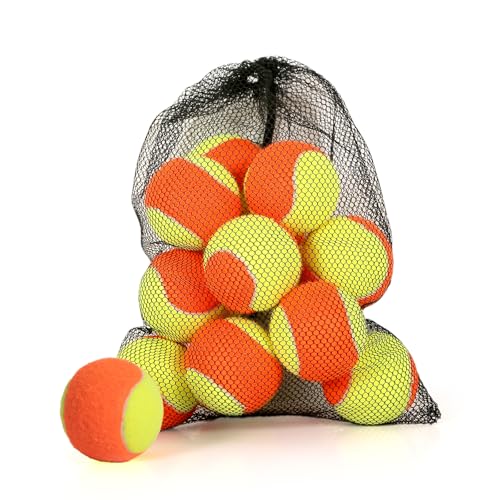
The MRYCZ FYRHD set uses 50% low compression to reduce bounce height, making it easier for beginners to make solid contact. Each ball is built for a consistent feel with natural rubber and durable felt. The 2.58-inch diameter mirrors standard balls, but the slower bounce helps kids learn proper technique without frustration. Best for younger players ages 6–12 who are just starting lessons or at-home practice. The reusable mesh bag adds storage and portability for travel or after-school practice. A limitation is that this pack is designed for beginners; advanced players may need faster balls for proper progression.
Wilson Youth Orange Balls: Starter Pace for 9–10 Years

Wilson’s US Open Orange balls are specifically marketed for stage 2- orange starter tennis and 9–10-year-olds. They are designed to be 50% slower than standard balls, which helps players learn stroke mechanics with less pace to manage. Best for early beginners who need extra time to prepare swings. Choose this if you want a Wilson-branded option known for consistent play. A potential limitation is that the single-can quantity may require replenishment after frequent practice sessions.
Wilson Red Balls: Large, Slow for 5–8 Year Olds

These Wilson Red balls are designed for younger players ages 5–8 with a larger appearance and a 75% slower pace than standard balls. The 75mm felt surface helps with ball tracking and court vision during early practice sessions. Best for early beginners who require a bigger, gentler ball to learn fundamentals. A note: for advancing players, the pace can become too slow, potentially reducing motivation to progress to regular balls.
SHYUJAJIE 20 Pack: Adjustable Low Compression

SHYUJAJIE offers three low-compression options (25%/50%/75%) in a single package, appealing to families who want to tailor pace as kids progress. The 50% setting suits beginners, while the 25% and 75% options enable a gradual training curve. The set includes a reusable mesh bag for easy transport. Best for multi-skill households or coaches who want variable pace drills. A caveat is the higher variety requires clear labeling to avoid confusion during practice sessions.
INSUM 12 Pack: Dog-Friendly Practice Balls

INSUM markets this 12-pack as beginner-friendly practice balls with a 2.5-inch diameter and bounce height around 135 cm. The set focuses on durability and a consistent feel, suitable for all court surfaces and even dog training activities. Best for households wanting cost-effective bulk practice. A limitation is that these balls are also marketed for pet training, which may influence construction differently from pure tennis-only balls.
ZHUOKECE 12 Pack: Durable Low-Compression Set

ZHUOKECE provides 12-pack balls with 2.56-inch diameter and about 3.28-foot bounce height. The product highlights durability and the use of natural rubber and durable felt, designed to simulate regular play while remaining learner-friendly. Best for lesson scenarios and practice machines where consistent ball performance matters. A caution: some users may want a slower pace for absolute beginners, which this pack addresses but varies by user velocity preferences.
Hanaive 24 Pack: Bulk 75% Low Compression

Hanaive’s 24-pack uses 75% low compression to significantly slow ball speed, making it ideal for very young players and short-court practice. The larger quantity supports frequent practice and family drills. Best for beginners who benefit from extra time to adjust stance and swing. A limitation is that the extreme slow pace may not suit kids who quickly progress to standard balls, requiring a transition plan to regular play.
Buying Guide: Key Purchase Considerations
Age and skill level: Younger players usually benefit from higher compression reductions (50%–75%). Match the ball pace to the child’s current swing speed and court size.
Court type and space: For small courts or garage setups, slower balls reduce risk of overshooting and improve control.
Durability and material: Look for natural rubber cores and durable felt to withstand regular practice across all surfaces.
Packaging and portability: Mesh bags help with transport and quick pickup during lessons or drills.
Progression options: If you want to grow with your child, consider balls offering multiple compression levels or a larger set to switch pace as skills develop.
FAQ
- Why choose low-compression balls for kids? They bounce slower and are easier to time, which helps kids develop proper technique without being overwhelmed by pace.
- What age range benefits most from these balls? Typically ages 5–12, but beginners of any age can benefit from slower balls during learning.
- Should I buy in bulk or a single can? Bulk packs are cost-effective for frequent practice or families with multiple kids; singles can be sufficient for casual players.
- Can these balls be used on all court types? Most are designed for all court surfaces, but check the product notes if you primarily train on synthetic or hard courts.
- When should a child transition to standard balls? When the child consistently demonstrates accurate timing, control, and reduced frustration with speed.
- Do these balls come with a bag? Several options include a reusable mesh bag for easy transport and storage.