Best Thermal Scope for Crossbow: Top Picks for Night Hunting and Precision
If you’re seeking a thermal scope for a crossbow, this guide highlights five top options that balance heat-sensing performance with practical use in the field. These choices are best for hunters who want quick target acquisition, reliable range estimation, and easy integration with night-time stalks. Each product is evaluated for who it suits best, potential limitations, and why it’s a strong pick compared to others in the same category.
Summary table of selected products:
| Product | Best For | Key Benefit | Limitations |
|---|---|---|---|
| Night hunts and mobile monitoring | Long battery life and real-time app streaming | Monocular, not a rifle scope | |
| Long-range detection | Integrated rangefinding and ballistic assist | RAV system may require calibration | |
| All-day sit-and-wait hunts | Extended runtime and multiple reticles | Heavier profile | |
| High sensitivity in varied terrains | Advanced image enhancement | Newer model, availability varies | |
| Extreme distance tracking | Highest magnification options | Wide feature set may require learning curve |
TOPDON TS004 Thermal Imaging Monocular

This handheld thermal monocular uses a 256×192 IR sensor with a 50Hz refresh rate for clear, real-time thermal views. It supports wireless connection to a phone, enabling live monitoring and capture through the TopInfrared app. An included 5000mAh battery yields up to 11 hours of operation, making it suitable for long excursions and scouting. Best for wildlife observers, trekkers, and hunters who want portable thermal tools without mounting a rifle scope.
Best for: Hunters who prioritize portability, long run-time, and companion-device streaming. Choose this if you value wireless monitoring and extended on-the-go usage over mounted rifle-scoped features.
Caution: This is a monocular, not a rifle-mounted scope, so it’s best paired with a compatible mounting solution for crossbow use or carried as a secondary monitoring device.
GOYOJO GRS225-RF Thermal Riflescope
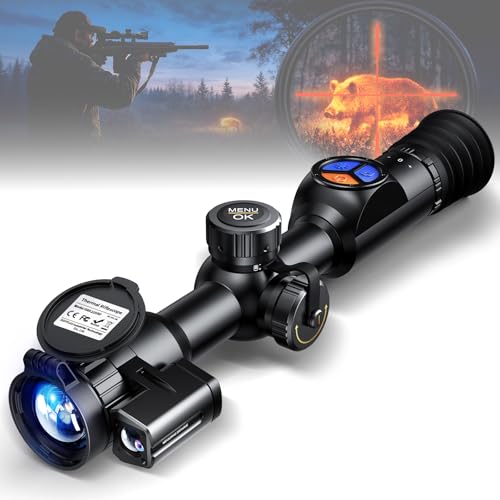
The GRS225-RF combines a 256×192 thermal sensor with 25mm optics and a 1440×1080 OLED display. It offers rangefinding and ballistic assistance, supporting precise holdovers at distance. A 1X–8X zoom and 50Hz refresh rate ensure smooth portrayal of moving targets. Best for: hunters who need integrated distance estimation and on-shot confidence across varied distances. Limitations: Lens cap instructions require reference to accompanying visuals for proper operation.
AGM Global Vision Rattler V2 25-256

The Rattler V2 provides extended range with a 25mm lens, 256×192 sensor, and up to 1,250 yards detection. It includes a removable power system delivering around 11.5 hours of runtime, multiple reticle options, and up to 8x digital zoom. Best for: long sits and late-night tracking where reliability and multiple reticle configurations matter. Caution: As a riflescope, it may require mounting compatibility checks for crossbow integration.
RIX Storm S2 Thermal Imaging Rifle Scope

The Storm S2 uses a 256×192 detector with a 25mm lens and 3.5x base magnification, extending to 14x with digital zoom. It features RET image enhancement to improve clarity in challenging terrain and a 50Hz refresh rate for smoother motion. Best for: hunters needing improved long-range visibility and image clarity in variable environments. Limitation: Availability and ongoing software updates may influence performance in some markets.
GOYOJO GRS225 Thermal Riflescope (Second Model)

The second GOYOJO GRS225 offers 256×192 thermal imaging with 25mm optics, and a 1440×1080 OLED display. It includes 1X–8X zoom, 50Hz refresh, and auto AI image enhancement with multiple imaging modes and 10 reticle options. Best for: hunters who need flexible imaging modes and enhanced edge details. Caution: Like other rifle scopes, ensure mounting compatibility with crossbows or auxiliary supports before use.
GOYOJO GRL325 Thermal Riflescope
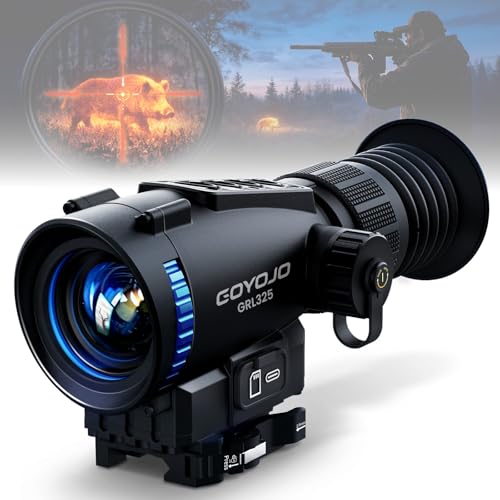
The GRL325 presents a 384×288 sensor with 25mm optics, 3–12X magnification, and a 1024×768 OLED. It delivers detections up to 1,640 yards and 55Hz imaging with Auto AI image enhancement. Best for: long-range precision hunting where higher magnification and better image detail are required. Limitation: Higher magnification and feature set may demand more user familiarity.
Buying Guide: Key Considerations For Crossbow Thermal Scopes
- Detection range vs. terrain: Choose a scope whose detection range matches typical hunting distances in your preferred terrain.
- Mounting compatibility: Verify crossbow mounting options and ensure the device can be secured or used in conjunction with a crossbow accessory.
- Image quality and refresh rate: Higher resolution and a 50Hz+ refresh rate provide smoother imagery for moving game.
- Power and runtime: Longer runtimes reduce the need for frequent battery swaps during longer hunts or scouting sessions.
- Built-in features: Rangefinding, ballistic calculators, reticle choices, and AI image enhancement can improve shot confidence in varied conditions.
- Portability and weight: Lighter devices reduce carry fatigue, especially for trekkers and mobile stalkers.
FAQ
- What is the difference between a monocular and a riflescope for crossbows?
A monocular offers portable, standalone thermal viewing and recording, while a riflescope provides aiming reticles, higher magnification, and ballistic tools. For crossbows, you may use a monocular for scouting and a separate scope for aiming, or choose a riflescope designed to mount with crossbow accessories. - Do thermal scopes work in complete darkness?
Yes. Thermal scopes detect heat signatures, so they function in total darkness as long as there is a heat contrast in the scene. - Is a higher refresh rate always better?
Generally, yes. A higher refresh rate (50Hz or more) yields smoother images, especially when tracking moving targets. - What should I consider about battery life?
Longer run times reduce interruptions during hunts, but consider whether the device supports hot-swapping batteries or external power sources for extended sessions. - Are integrated rangefinders essential for crossbow hunting?
Not essential, but rangefinders and ballistic aids can improve accuracy at longer distances or in dense brush, making them a valuable feature for some setups. - Can these devices be used as backups for daytime shooting?
Yes, many models offer recording and image capture that can assist with non-hunting surveillance or wildlife observation in low light.