Best Thermal Scopes for AR: Clear Night Vision for Precision Arms Hunting
When shopping for an AR-compatible thermal scope, you need models that deliver reliable heat signatures, long detection ranges, and quick target acquisition. This guide highlights five top options across budgets and feature sets, helping shooters choose the right match for their needs. Best for hunting at night, pest control, or security patrols, these options balance sensitivity, durability, and ease of use. The buyer profiles include beginners seeking affordability, serious hunters needing long-range clarity, and professionals requiring advanced imaging and rangefinding capabilities.
| Product | Best For | Key Strength |
|---|---|---|
| RIX Storm S2 Thermal Imaging Rifle Scope | Mid-to-advanced hunters | High sensitivity, wide field of view |
| GOYOJO GRS225-RF Thermal Riflescope | Long-range hunting | 8X zoom, rangefinding, ballistic aid |
| GOYOJO GRS225 Thermal Riflescope | All-round versatile use | Auto AI image enhancement |
| DNT Optics Hydra 256×192 | Entry-level to budget-conscious | Multi-function (standalone/clip-on/handheld) |
| CVLIFE Thermal Scope | Budget-minded seekers | High sensitivity with long detection |
RIX Storm S2 Thermal Imaging Rifle Scope

The RIX Storm S2 features a 256×192 thermal detector with a 25mm objective and a 3.5x to 14x magnification range. A 7.0° horizontal field of view enables clear target identification at extended distances—up to approximately 1,422 yards in favorable conditions. RIX’s RET image enhancement further improves clarity by processing the thermal data to approach higher-detector performance. Best for experienced hunters and professionals who need clearer long-range imaging in varied weather conditions.
Best for: Long-range hunting and tactical scenarios where target recognition at distance matters. Caution: Thermal performance may vary with weather and concealment conditions; ensure proper zeroing before field use.
GOYOJO GRS225-RF Thermal Riflescope
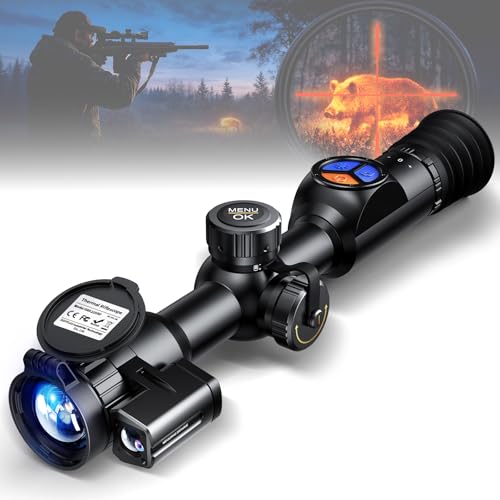
The GRS225-RF packs a 256×192 thermal sensor with <35mK sensitivity, a 25mm objective, and a high-resolution OLED display. It delivers long-range heat detection up to about 1,224 yards and includes integrated rangefinding and ballistic assistance to improve holdover under field conditions. The 1X–8X optical magnification and 50Hz refresh provide smooth tracking of moving targets. Best for: Hunters needing range estimation and ballistic support for distant game. Caution: Lens cap opening instructions should be followed to avoid misalignment after field use.
GOYOJO GRS225 Thermal Riflescope (Non-RF)

The non-RF GOYOJO GRS225 shares the same 256×192 sensor and <35mK sensitivity with a 25mm lens, offering long-range heat detection up to 1,224 yards and a high-resolution OLED panel. It features 1X–8X zoom and a 50Hz refresh rate for smooth visuals, plus Auto AI image enhancement with multiple imaging modes and reticle options. Best for: All-round use with advanced image processing for clearer terrain. Caution: AI enhancement configurations may require initial setup to match lighting conditions.
DNT Optics Hydra 256×192

The Hydra is a versatile entry-level option offering standalone, clip-on, and handheld use. It uses a 256×192 sensor with 25mm optics and 50 fps imaging, delivering clear real-time thermal vision in a compact form. It also employs ISR (super resolution) to sharpen detail, approximating a higher detector image. Best for: Budget-conscious users who want flexibility and simplicity. Caution: As an entry-level model, ultra-long-range detection may not match higher-end units in extreme conditions.
CVLIFE Thermal Scope for Hunting

The CVLIFE scope uses a high-sensitivity 256×192 sensor with 12 μm pixel pitch and NETD under 50 mk, complemented by a 50Hz refresh rate and a 1024×768 OLED display. It offers 3.1x base magnification with 1–4x electronic zoom for quick identification in the field. Best for: Budget-minded buyers seeking reliable thermal performance for deer, hogs, and varmints. Caution: Lower-end optics can have more challenging edge detail in dense brush; use in conjunction with proper range estimation.
Buying Guide: Key Considerations For AR Thermal Scopes
- Detector resolution and sensitivity: A 256×192 sensor with 25mK or better provides clearer targets at distance. Higher sensitivity helps in cooler conditions.
- Magnification and field of view: Balance base magnification with the intended hunting distance. Wider FOV helps initial target acquisition; higher magnification aids distant identification.
- Frame rate: 50 Hz sustains smooth motion tracking of moving targets, especially in dynamic scenarios.
- Image enhancement and AI features: Auto AI or RET technologies improve edge definition and contrast in complex terrain.
- Rangefinding and ballistic support: Built-in rangefinders and ballistic calculators reduce guesswork when taking shots at distance.
- Durability and water resistance: Look for IP ratings and rugged housings if hunting in rain or rugged environments.
- Power and runtime: Removable batteries with extended runtime are valuable for long hunts; check battery type compatibility.
- Weight and balance: Heavier scopes affect AR balance; ensure the setup remains comfortable for extended use.
Frequently Asked Questions
- What is NETD and why does it matter?
NETD (noise equivalent temperature difference) indicates thermal image clarity; lower numbers mean crisper details at distance.
- Is a higher refresh rate always better?
Yes, 50Hz or higher provides smoother motion, improving target tracking for moving animals.
- Do these scopes require special mounts for AR use?
Most are designed for standard rifle mounts, but verify compatibility with your specific AR platform and mounting rail.
- Can thermal scopes replace night vision entirely?
The option provides heat signatures in complete darkness, but performance varies by distance and environment; some hunters pair with additional daylight optics.
- What maintenance is needed?
Regularly inspect seals, clean lenses with proper materials, and store in a dry, climate-controlled place to extend lens life.