Best Thermal Scopes for Hunting: Top Picks for Precision and Stealth
Looking for the best thermal scopes for hunting? This guide highlights five reliable options that balance long-range heat detection, image clarity, and ease of use for different hunting scenarios. Ideal buyers include long-range hunters, night stalkers, and those targeting wary game in brushy terrain. The table below summarizes the featured models to help you compare at a glance.
| Product | Key Strength | Best For |
|---|---|---|
| GOYOJO GRS225-RF Thermal Riflescope | High sensitivity sensor, long detection range, built-in rangefinding | Hunting coyotes or hogs at distance |
| AGM Global Vision Rattler V2 25-256 | Extended runtime, versatile reticles, strong rangefinding | All-night or multi-hour hunts |
| TOPDON TS004 Thermal Imaging Monocular | Portable monocular with long battery life and app connectivity | Spotting and monitoring from a lightweight device |
| RIX Storm S2 Thermal Imaging Rifle Scope | High sensitivity and wide zoom range | Long-range field work with crisp imaging |
| CVLIFE Thermal Scope for Hunting | High sensitivity sensor and compact design | Lightweight setup for quick stalks |
GOYOJO GRS225-RF Thermal Riflescope for Hunting
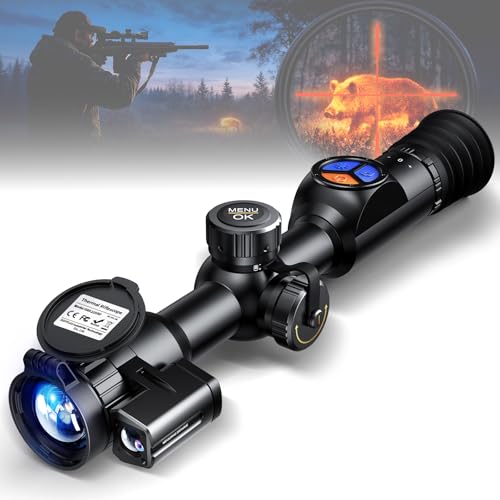
Best for hunters who need long-range heat detection with integrated rangefinding. This GOYOJO model features a 256×192 thermal sensor, 25mm objective lens, and a high-resolution OLED display for clear target identification. The 1X–8X optical magnification and 50Hz refresh rate support smooth tracking of moving game, while built‑in ballistic assistance helps with holdover calculations—especially useful for coyotes at distance or hogs in thick cover. The scope’s range of up to 1,224 yards allows you to plan ambush points with confidence. A caveat: users should review lens cap instructions in the provided imagery for proper use.
Who it’s best for: Long-range hunters who prioritize heat detection and on-device range estimation. Why chosen: Combines strong thermal sensitivity with practical ballistic tools for swift, accurate shooting.
AGM Global Vision Rattler V2 25-256 Thermal Rifle Scope

Best for all-night or extended hunts where dependable power matters. The Rattler V2 uses a 25mm Germanium lens and offers up to 11.5 hours of runtime with a removable power system, making it suitable for long sits. It provides a 1,250-yard detection distance, multiple reticle options, and digital zoom up to 8x, plus a stadiametric rangefinder for quick distance estimation. Caution: If you rely on the removable power system, ensure you carry a spare battery or charger to avoid runtime interruptions during hunts.
Who it’s best for: Hunters who stay out late or through dawn and need reliable power with flexible reticle options. Why chosen: Strong endurance and robust feature set support all-day hunting sessions.
TOPDON TS004 Thermal Imaging Monocular

Best for flexible, portable observation and quick scouting. The TS004 offers 256×192 IR resolution at 50Hz, delivering crisp real-time images in the field. A standout feature is its 5000mAh battery life, enabling up to 11 hours of operation. It also supports wireless connection to a mobile app for live monitoring, image capture, and video recording, even when offline. Limitation: While excellent for scouting and handheld use, it is a monocular and not a riflescope, so it’s best for early detection or static observation rather than long-range shooting adjustments.
Who it’s best for: Spotters and stalkers who value portability and extended battery life. Why chosen: Combines high clarity with practical connectivity for rapid situational awareness.
RIX Storm S2 Thermal Imaging Rifle Scope for Hunting

Best for hunters who demand high sensitivity and flexible magnification. The Storm S2 features a 256×192 detector, a 25mm lens, and a base magnification of 3.5x with digital zoom up to 14x. Its 50Hz refresh rate supports smooth tracking, while image enhancement through advanced RET algorithms improves target visibility in challenging terrain. Limitation: While offering strong long-range performance, the scope’s weight and balance on lighter rifles should be considered for all-day use.
Who it’s best for: Long-range enthusiasts and tactical-style setups where image clarity at distance matters. Why chosen: Superior image processing and wide zoom range help identify targets in open terrain and brush alike.
CVLIFE Thermal Scope for Hunting

Best for compact, budget-conscious setups that don’t sacrifice essential thermal performance. The CVLIFE scope uses a 256×192 sensor with 12 μm pixel pitch and NETD under 50 mK, delivering clear images on a 1024×768 OLED display. It includes a 3.1x base magnification with 1–4x electronic zoom, and a removable power system to provide up to 10 hours of operation. Caution: The compact design may limit long-range capabilities compared to larger, high-end models.
Who it’s best for: Hunters seeking a lightweight, economical option for quick stalks and brief pursuits. Why chosen: Solid thermal performance in a smaller form factor with practical power options.
Buying Guide: Key Considerations For Thermal Scopes
- Sensor resolution and NETD: Higher resolution and lower NETD yield crisper images and better target discrimination, especially in dense cover.
- Refresh rate: 50Hz is common; higher rates offer smoother motion tracking for fast-moving game.
- Magnification and field of view: Base magnification matters for identification; digital zoom helps at longer distances but can degrade image clarity.
- Power and runtime: Removable batteries provide flexibility for long hunts; consider models with extended runtime for overnight trips.
- Reticles and image processing: Multiple reticles and AI image enhancement can improve shot placement in challenging environments.
- Weight and balance: Heavier scopes affect rifle handling; balance matters for long stints in the field.
- Waterproofing and durability: IP ratings and rugged construction help in damp or brush-heavy conditions.
- Connectivity: App integration or wireless data transfer can aid scouting and documentation, especially for planning hunts.
Frequently Asked Questions
- What should I look for in a thermal scope for hunting?
A: Prioritize resolution, NETD, refresh rate, range capability, and battery life to suit your typical hunting scenario. - Is a monocular useful if I mostly need a riflescope?
A: Monoculars are great for scouting and map-based planning but lack integration for long-range shooting. They complement riflescopes, not replace them. - Can thermal scopes detect animals through brush?
A: Yes, thermal imaging excels at detecting heat signatures through vegetation, though dense foliage can still obscure small targets. - How important is battery life for a night hunt?
A: Very important. Longer runtime reduces the risk of power loss during extended sits; consider models with removable batteries or external power options. - Do higher prices guarantee better performance?
A: Not always. Look for a balance of sensor quality, optics, and user features that fit your use case and budget. - Can I mount a thermal scope on any rifle?
A: Most thermal scopes are designed for standard rifle mounts, but ensure compatibility with your rifle’s mounting system and recoil tolerance.