Best Timing System for Track and Field: Fast, Accurate Sprint Timers for Training
Finding a reliable timing system for track and field is essential for evaluating sprint performance, progress over a season, and coaching fast-twitch athletes. This guide highlights five top timing systems designed for straight-line sprints, shuttle runs, and speed drills. They suit coaches, athletic programs, and individual athletes who want quick setup, clear readouts, and repeatable results. The following selections emphasize ease of use, portability, and accurate timing across indoor and outdoor settings.
Summary table of chosen products
| Product | Best For | Key Feature |
|---|---|---|
| SKLZ Speed Gates Electronic Sprint Timer System | Programs needing automated start-to-finish timing over 20 yards | 50-record memory, sensor-based start/finish |
| Ousmile Wireless Laser Timer (First)** | Short to mid-distance sprints, all-day training | Wireless, long standby, bright LED display |
| Flyrivergo Powered Wireless Laser Timer | Height-adjustable setup for precise timing | Adjustable tripods to 5.25 ft, HD display |
| GAN XIN 40/60 Yard Sprint Timer | Versatile timing for various sprint distances | Adjustable setup, built-in battery |
| YZ Laser Timer For Sprints | Portable laser-based timing with compact kit | Five-digit display, high accuracy |
SKLZ Speed Gates Electronic Sprint Timer System

The SKLZ system uses sensor-based timing for start and finish gates, measuring runs up to 20 yards. It’s ideal for coaches who want automated timing for the 20-yard dash, shuttle drills, or base-to-base sprints. The unit stores the last 50 times, enabling quick progress comparisons between athletes or across a season. Lights on the sensors verify alignment and readiness, reducing setup guesswork. Best for programs that value immediate, paperless data and straightforward drill timing.
Best for coaches who need quick, automated results with simple verification indicators. This system is especially suitable for football, baseball, soccer, and track athletes focusing on acceleration and straight-line speed. Caution: the 20-yard range may be limiting for longer sprint training or complex multi-direction drills.
Ousmile Wireless Laser Timer for Sprints (First)

The Ousmile wireless laser timer requires no power bank, turning on and going. It boasts up to 10 hours of battery life, making it suitable for full practice sessions without frequent recharging. The bright LED display remains readable indoors or outdoors, day or night, aiding visibility in varied lighting. It’s best for athletes who need a lightweight, self-contained timing solution that’s easy to deploy during drills and scrimmages. Potential limitation: battery management is critical for longer camps.
Best for all-day training with a simple, ready-to-run setup. Choose this if you value battery life and a clear LED readout over longer-range timing features. Avoid if you require automatic start/stop gates or longer-range measurements beyond sprint drills.
Flyrivergo Powered Wireless Laser Timer

This timer emphasizes precision with a high-performance chipset and a bright HD display for easy visibility, even in bright outdoor light. It includes four height-adjustable tripods up to 5.25 feet, enabling exact timing at different athlete heights and sprint setups. A built-in lithium battery supports up to eight hours of continuous use, and a rugged carrying case aids transport. Best for clubs or schools that train with multiple sprint setups and require adaptable tripod height. Limitation: higher initial cost and heavier carrying weight than compact units.
Best for versatile, high-precision timing in varied environments. Opt for this if you need adjustable height for precise starts and a durable case for on-field use. Consider alternatives if you require ultra-lightweight, pocket-size timing solutions.
GAN XIN 40/60 Yard Sprint Timer
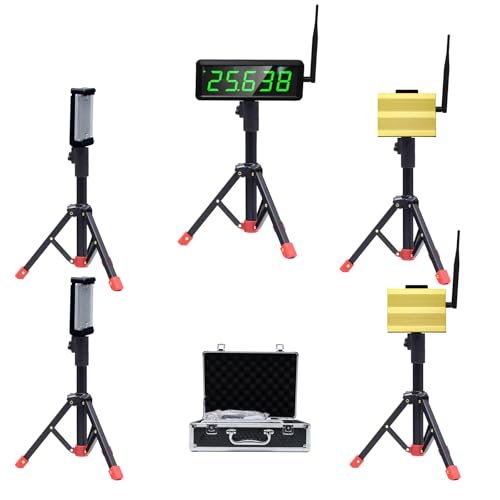
The GAN XIN timer supports 40 and 60-yard sprint timing with options for different competition formats. It mentions a built-in battery and an easy “zero” reset, with a five-digit display accurate to 0.001 seconds. This unit is positioned for track and field training, optioned for nearby coach oversight and straightforward data capture. Best for athletes who need quick-start, precise timing across short to mid sprints. Caution: some features rely on separate brackets that may be sold separately, so plan for add-ons if needed.
Best for engineers and timers requiring tight numerical precision at common sprint distances. Choose this if you value fast reset and portable battery-powered operation. Avoid if you need a complete, all-in-one tripod system without extra purchases.
YZ Laser Timer For Sprints

The YZ Laser Timer uses a five-digit display with a claimed 0.001-second precision, making it a compact option for precise speed work. The kit includes multiple accessories such as reflectors and stands, aiding portability and quick setup for on-field sessions. Best for teams needing a lightweight, easily transportable timing solution. Limitation: latency and interference are not detailed, so outdoor use in busy venues should be tested before a formal event.
Best for portable, ready-to-go timing with a compact kit. Opt for this if you prioritize a small footprint and straightforward operation. Avoid if you require a broader feature set, such as multiple gates or extensive data memory in a single device.
Buying Guide: Key Considerations For Track And Field Timing Systems
What distance do you time most often? For 40 or 60-yard sprints, ensure the device supports those ranges and has accurate start/finish detection. If you focus on acceleration and shuttle drills, a sensor-based or laser system with reliable gate alignment matters more than long-range timing.
How portable must the system be? Lightweight timers with built-in batteries and compact tripods suit field use and quick drill setups. Heavier, tripod-based units offer stability for longer sessions but require transport planning.
What level of data storage do you need? Some units memorize the last 50 or more times, enabling quick comparisons. Consider whether you need cloud syncing, season-long progression tracking, or simple on-device readouts.
Is a display readability a priority? Outdoor use under sun or indoor gyms with bright lighting may require high-contrast displays or LED readouts. Ensure the unit remains legible from a suitable distance for coaches and athletes.
What about calibration and setup? Systems with simple alignment indicators reduce setup time and errors. Look for sensor or gate alignment LEDs, and avoid models requiring extensive calibration routines before each drill.
Budget and durability are practical considerations. Wireless timers with long battery life tend to be more expensive but save maintenance time. Consider durability for outdoor environments and transport cases for frequent travel between venues.
Frequently Asked Questions
- What is the most important feature in a track timing system? Accurate start/finish detection and ease of use, plus reliable data storage for progress tracking.
- Can I use a laser timer for all sprint distances? Laser timers are great for short to mid-range sprints; confirm the device supports your target distances.
- Do these systems require calibration? Many have simple alignment indicators; some may require occasional calibration depending on the model.
- Which is best for coaches who train multiple athletes at once? Systems with memory and side-by-side comparison features help coaches review multiple athletes quickly.
- What accessories improve timing accuracy? Adjustable tripods, reflectors, and clear start/finish gates improve alignment and reduce measurement error.
- Are all models suitable for indoor and outdoor use? Most listed timers are designed for both environments, but check display readability and battery life for outdoor sessions.