Best Trolling Motor for Canoe: Top Picks for Stable, Quiet Forward Motion
If you’re shopping for a trolling motor for a canoe, you want reliable, compact, and quiet propulsion that’s easy to control on calm lakes and slow-moving rivers. The following five models are among the most suitable for canoes, offering compact shafts, steady thrust, and simple mounting. They’re best for occasional anglers, light-travel canoes, and paddlers seeking hands-free control for long days on the water. The table below briefly compares key options to help you decide quickly.
Product Comparison Snapshot
| Product | Thrust | Shaft | Best For |
|---|---|---|---|
| Minn Kota Endura C2 Transom-Mount Electric Trolling Motor – 30 Lb. Thrust | 30 lb | 30 in. | Lighter canoes, casual anglers |
| Minn Kota Endura C2 Transom-Mount Electric Trolling Motor – 50 Lb. Thrust | 50 lb | 42 in. | Heavier loads, stronger wind |
| Newport NV-Series 36lb Thrust Transom Mounted Electric Trolling Motor | 36 lb | 30 in. | Saltwater or freshwater, kayak/canoe blends |
| Newport Kayak Series 36lb Thrust Transom Mounted Saltwater Motor | 36 lb | 24 in. (Kayak shaft) | Low-profile, compact setup |
| 55lb Thrust Trolling Motor By BODIOO | 55 lb | 30 in. | More thrust in flat to moderate chop |
Minn Kota Endura C2 Transom-Mount Electric Trolling Motor – 30 Lb. Thrust
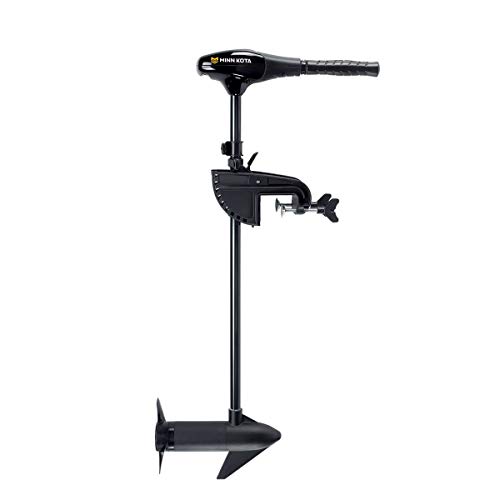
Best for light canoes and casual fishing trips, the Endura C2 30 Lb model emphasizes ease of use and straightforward mounting. Its Telescoping Tiller extends up to 6 inches for comfortable control, while a push-to-test battery meter helps monitor power at a glance. A 10-Position Lever Lock Bracket makes angle adjustments quick and secure, and the reinforced composite construction resists UV damage, keeping it durable in marine environments. The Power Prop for Heavy Vegetation boosts thrust through dense cover. Choose this if you want a compact, simple setup with reliable performance in calm waters.
Best for: Light-duty canoe setups, beginners, weekend anglers. Limitation: Lower thrust means slower response in wind or current; consider higher thrust models for windy conditions.
Minn Kota Endura C2 Transom-Mount Electric Trolling Motor – 50 Lb. Thrust
This higher-thrust version is better for canoe setups that encounter stronger winds or heavier loads, such as heated gear or longer trips. It shares the same user-friendly features as the 30 Lb version—6-inch telescoping tiller for ergonomic control, push-to-test battery meter, and a durable, UV-resistant composite housing. The 42-inch shaft provides more depth placement options, which can help in deeper water or when mounting on boats with higher transoms. Choose this if you often paddle in breezy conditions or carry extra gear.
Best for: Heavier canoes, windy days, longer trips. Limitation: Heavier and longer shaft may feel less maneuverable in tight streams or narrow creeks.
Newport NV-Series 55lb Thrust Saltwater Transom Mounted Trolling Motor

Designed for stronger propulsion, this Newport NV-Series 55lb model delivers robust performance with a 30-inch shaft and LED battery meter. It’s built for reliability in saltwater and freshwater environments, with a 5-forward/3-reverse speed range. The motor head offers adjustable mount height and direction, enabling precise control over a canoe’s steering and speed. Best for: Canoes expected to face choppier water or require more thrust for planing under load. Limitation: Higher thrust often accompanies greater weight and longer shaft; may be overkill for calm inland lakes.
Newport Kayak Series 36lb Thrust Transom Mounted Saltwater Motor
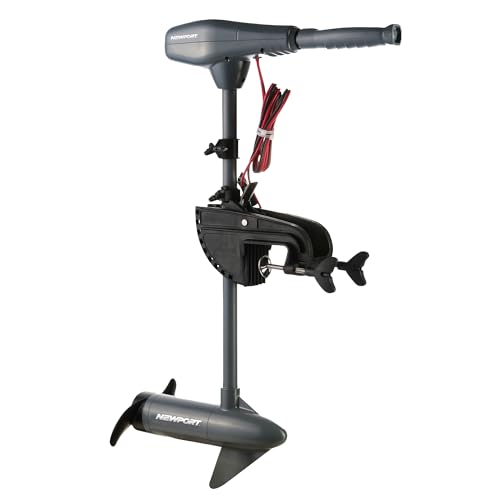
This Kayak Series model is slim and compact, with a 24-inch fiberglass shaft aimed at kayaks and canoes that require a short reach. It has 8 speeds (5 forward, 3 reverse) and a 6-inch telescoping handle for comfortable control. The all-aluminum motor head and corrosion-resistant hardware make it suitable for saltwater and freshwater use. Best for: Lightweight canoe setups where a shorter shaft and compact profile are preferred. Limitation: Smaller shaft may be less ideal for deep water or higher transom mounting on taller boats.
55lb Thrust Trolling Motor 8 Speed For Kayaks And Canoes – Black

This 55 Lb thrust model offers strong propulsion for larger canoes or when pushing through wind and current. It features an 8-speed setup with a 6-inch extendable handle and a 30-inch shaft, making it versatile for varying boat heights and water depths. The design emphasizes quiet operation to minimize fish-spooking. Best for: Canoes used in open water with occasional headwinds, where maximum thrust is necessary. Limitation: Higher thrust can drain batteries faster; plan for greater battery capacity.
Buying Guide: Key Considerations For Canoe-Tocused Troll Motors
What size and thrust do I need?
For small to mid-size canoes on calm water, 30–36 lb thrust is typically sufficient. If you frequently paddle in windy days or carry more gear, consider 50–55 lb thrust. Higher thrust provides quicker acceleration and better maneuverability in currents but consumes more battery.
How long should the shaft be?
Shalt length should position the propeller below the hull’s stern to prevent cavitation and improve thrust. A 30-inch shaft is common for many canoes and kayaks, but a 24-inch shaft can work for lower transoms or compact setups. If your boat sits high on the waterline, a longer shaft may be beneficial.
Is saltwater compatibility important?
For canoe use in coastal or brackish waters, saltwater-rated motors are advantageous due to corrosion resistance. If you’ll operate mainly in freshwater lakes, a standard freshwater model usually suffices.
How many speeds matter?
Most users do well with 5 forward and 3 reverse speeds. More speed options offer finer control for delicate trolling and precise docking or repositioning in tight spaces.
Maintenance and durability considerations
Look for a reinforced composite or similarly durable housing, UV resistance, and a propeller designed to handle vegetation. A built-in battery indicator helps you avoid sudden power loss on the water.
Installation and compatibility
Ensure the motor fits your canoe’s transom and mounting bracket. Check whether the motor uses standard mounting hardware and compatible propellers. Easy-release bracket systems simplify adjustments during a trip.
FAQ
- What is the best trolling motor for a lightweight canoe? A motor with about 30–36 lb thrust and a 30-inch shaft is typically ideal for a lightweight canoe, offering easy control and sufficient power without excessive weight.
- Do I need a saltwater-rated trolling motor for inland lakes? Not necessarily. Saltwater-rated motors are more corrosion-resistant, beneficial if you boat near coastal areas or brackish water, but freshwater motors perform well on inland lakes.
- How important is shaft length for a canoe? Proper shaft length positions the propeller below the hull. A shaft that is too short may cavitate or strike water, while a shaft that’s too long can hinder maneuverability in narrow channels.
- Can I upgrade the thrust later if my canoe changes? Yes. Upgrading to a higher-thrust model is possible if your canoe’s weight or typical wind conditions change, but ensure your battery capacity and weight budget can handle the increased load.
- What maintenance helps extend trolling motor life? Regularly check propeller for damage, keep the connectors clean, and rinse saltwater units after exposure to prevent corrosion. Inspect the mounting bracket for secure fit.