Best Waist Lights for Running: Top Picks for Night Time Safety
Answering the need for hands-free visibility, these waist lights are among the best options for nighttime runners. Ideal buyers include dedicated runners who want stable, low-bounce comfort, hikers who run at night, and walkers who need hands-free illumination. This guide highlights five waist-appropriate lights, with quick-fit notes, runtimes, and why each stands out. A concise buying table follows to help you compare at a glance.
Buying at a glance: recommended picks for different needs
- Best overall for stability and multi-position wear: BIKACU Running Light
- Best for long runtimes and adjustable beams: ISEYOU Running Lights
- Best clip-on flexibility and bounce-free design: noxgear Nomad Clip-On
- Best high-visibility wide beam: Hopedone Running Light
- Best lightweight belt with pro-grade features: Ultraspire Lumen 600 5.0
BIKACU Running Light: 500 Lumens, 5 Modes

Best for versatile wear: chest, waist, or head. This all-in-one light uses 40 white LEDs and 9 red LEDs, delivering up to 500 lumens and visibility up to 200 feet. The dual-switch design allows independent control of white and red beams, enhancing safety for night running, camping, or fishing. The reflective straps add extra visibility in low-light environments. A caveat: the ability to wear it in multiple modes may require some adjustment for optimal fit during dynamic runs.
Who it’s best for: runners needing a single light that can switch between chest, waist, or head-mounted use without purchasing extra gear. The flexibility helps people who frequently switch activities or carry other reflective equipment.
Why selected: strong all-around performance, good beam spread, and practical dual-beam control make it a standout option for varied night activities. The wide illumination and reflective design help improve situational awareness on sidewalks and trails.
Limitations to note: some users may prefer lighter-weight belts for short, fast runs where every gram matters.
ISEYOU Running Lights: 500 Lumens, 45° Tilt
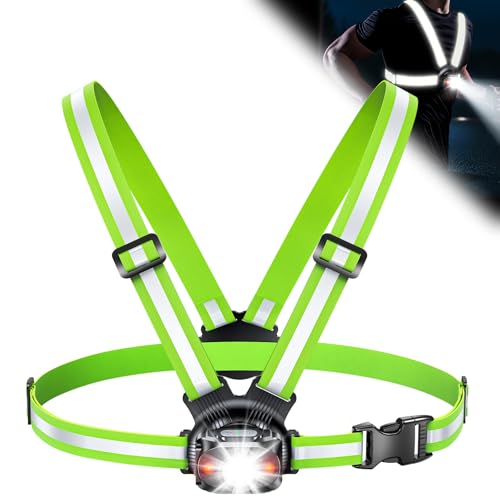
Best for long-duration runs and stable fit: ISEYOU combines a bright 500-lumen beam with a 45° adjustable tilt and a 360° reflective vest. Its USB-C rechargeable battery supports 4–16 hours of use depending on mode, which makes it suitable for longer night routes or weekend adventures. The dual-strap design distributes weight evenly for comfort during extended wear. One caveat is that higher brightness drains the battery faster than red-only modes.
Who it’s best for: runners who value a predictable battery life and a secure, comfortable fit across varied terrains. It’s especially suitable for those who run on longer night routes where consistent illumination matters more than ultra-short bursts.
Why selected: the combination of a high output with a 360° reflective vest and a USB-C fast-charge system makes it a practical, versatile choice for urban night runs and park trails alike.
Limitations to note: the 500-lumen maximum can be intense in close quarters; use lower modes in crowded areas to preserve battery.
Ultraspire Lumen 400Z Waist Light Belt

Best for lightest weight with steady output: The 400Z 3.0 features low-weight construction with a steady beam that maintains consistent brightness until battery depletion. Its conical belt shape and balanced load distribution promote a no-bounce ride, which is important for runners who dislike movement of light during stride. It is compact and unobtrusive, but the lower lumens limit exposure on very dark trails compared to brighter models.
Who it’s best for: runners who prioritize minimal on-body feel and a steady, comfortable beam over maximum brightness. Ideal for those who run on well-lit or mixed-terrain paths where subtle, reliable illumination suffices.
Why selected: stability and efficiency stand out in the waist-light category, with a design emphasis on comfort for long sessions and a natural running motion.
Limitations to note: not the brightest option for expansive, pitch-dark trails where higher lumens offer a wider visual field.
Ultraspire Lumen 600 5.0 Waist Light Belt

Best for pro-grade features and a larger beam: The 600 5.0 belt blends a wide beam with advanced fit and durability. It integrates multiple technologies designed to reduce fatigue over long sessions, including a conical belt shape for a stable ride and a wide beam that mimics daylight coverage. The belt supports a sizing range of 26” to 38” and uses USB Type-C for quick charging. This option is well-suited for runners who demand more nuanced beam control and extended use in varied weather.
Who it’s best for: athletes who train long distances, run in mixed environments, or compete in night-time events where consistent, ample illumination is essential.
Why selected: the combination of wide beam, low-weight materials, and ergonomic fit makes it a reliable choice for intense night workouts and endurance training.
Limitations to note: higher-end features may come with a higher price point and slightly more setup time for optimal fit.
Buying Guide: What to Consider When Choosing a Waist Light for Running
- Brightness and beam pattern: Decide if you need a wide flood beam for nearby ground or a more focused beam for distant visibility. Models like the 500–600 lumen range offer solid versatility for urban and trail runs.
- Wearability and stability: Look for dual straps or clip-on designs that minimize bounce. A stable clip helps reduce movement at high speeds or on rough terrain.
- Battery life and charging: Consider runtime in your typical running window. USB-C charging is convenient for quick top-ups before dawn or post-workouts.
- Weather resistance: If you run in rain or damp conditions, IP rating (like IPX4–IPX5) can influence reliability and longevity.
- Versatility: Some lights can be worn as chest or waist belts, or even attached to a hat or car for emergencies. This can be useful if you cross between activities.
- Ease of use: Separate controls for white and red lights can be helpful for adjusting quickly without taking your eyes off the path.
- Weight and balance: Lighter options reduce fatigue; however, heavier models may offer longer battery life or brighter beams. Choose based on your typical run length and terrain.
Frequently Asked Questions
- Do waist lights offer better stability than headlamps?
– Waist lights can provide stable, bounce-free illumination when properly worn, especially with dual-strap designs. They also keep your head free from strain during long runs. - How bright should a waist light be for nighttime urban running?
– 300–500 lumens is typically sufficient for sidewalks and streets. Higher lumen levels are beneficial for unlit trails. - Is red light useful for running safety?
– Yes. Red LEDs increase visibility to others without washing out your night vision, which helps in low-light environments. - Can I use a waist light for dog walking?
– Yes. Many waist lights double as clip-on or chest lights, aiding visibility during dog walks at night. - How long do these lights last on a single charge?
– Depending on mode, many waist lights offer several hours of white or red illumination. USB-C models tend to provide quicker top-offs for frequent use.