Best Walking Equipment for Elderly: Safe Transfer Belts, Walkers, and Standing Aids
When choosing walking equipment for elderly loved ones, prioritize safety, ease of use, and fit. The top products below are suited for caregivers, physical therapists, and family members helping with transfers, standing, and mobility. This guide highlights five options that balance support, versatility, and accessibility for daily living. A quick summary table follows to compare core capabilities at a glance.
| Product | Best For | Key Benefit | Limitations |
|---|---|---|---|
| Vive Gait Belt | Caregivers needing secure transfers | 7 padded handles for versatile grip | Up to 350 lbs |
| GHOSOONE Adult Standing Walker | Lower-limb training and standing support | Multiple adjustable levels for fit | Heaviest frame among options |
| HONEYBULL Foldable Cane | Mobility on the go | Heavy-duty, foldable, lightweight | Single-point support |
| DnyioVpl Standing Walker | Safe rehab and stability | Wide base with 220 lbs capacity | Complex adjustment mechanism |
| Vive Stand Assist | Standing up from seating | Dual handles, easy installation | Best used with cushioned seats |
Vive Gait Belt (350lbs) Transfer Belt With Handles

The Vive Gait Belt is designed for safe transfer and patient assistance. It supports up to 350 lbs and features seven padded handles, allowing caregivers to choose grips that suit the transfer angle and patient condition. This makes transfers and standing support less risky for both caregiver and patient. The belt can fit waists up to 51 inches, and a sturdy metal buckle with a quick-release latch enables easy removal. Best for caregivers managing patient transfers in homes or clinical settings. A potential limitation is its reliance on proper belt positioning to maximize leverage and safety.
GHOSOONE Adult Standing Walker For Seniors

This standing walker is designed for rehabilitation and leg training, with heights suitable for 58 to 71 inches and a 220 lbs capacity. It offers two types of supportive pads and a removable panel for resting, plus elastic cords to aid leg muscle training. Its adjustable height (10 levels) and width (5 levels) support various body shapes. It’s best for users recovering from surgery or those needing guided, seated-to-standing transitions. Limitations include a relatively heavy frame that may be less convenient for frequent transport.
HONEYBULL Folding Walking Cane

The HONEYBULL walking cane is a foldable, adjustable aid designed for everyday use. It is lightweight yet built with a strong aluminum frame, height-adjustable from 30″ to 36″, and suitable for a wide range of heights from 5′ to 6’5″. The collapsible design makes travel and storage easy, and its heavy-duty construction offers reliable support for steady walking. Choose this if you want a portable, discreet mobility aid. A possible drawback is that it provides single-point support rather than full stability like walkers.
DnyioVpl Standing Walker For Seniors

The DnyioVpl standing walker emphasizes stability with a 220 lbs load capacity and a wide base. It combines two side wheels and two rear wheels to reduce rolling and backward tilting, providing safer movement for seniors and post-operative patients. Height is adjustable in ten levels (45.67–55.12 inches) and width in five levels (7.87–13.78 inches). This makes it a solid choice for long-term use and varying user dimensions. Limitation: assembly and adjustment may require careful alignment to maintain stability.
Vive Stand Assist

The Vive Stand Assist is a mobility rail designed to help individuals rise from couches or chairs. Its dual-handled design provides a stable base for pushing up to a standing position, reducing twisting movements that can lead to falls. It is easy to install around cushioned seats and supports up to 300 pounds with a durable aluminum frame. Best for homes with sofa-based seating and for anyone needing consistent standing support. Limitation: effectiveness depends on cushion fit and seat height.
LpqOxnm Adult Standing Walker
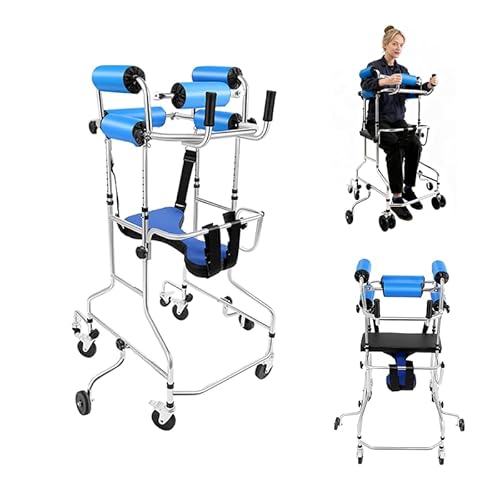
This standing walker focuses on safety and balance for seniors with reduced mobility. Its carbon steel frame provides durability, and a wide base increases stability with a 220.46 lbs load capacity. It combines two side wheels and two rear wheels to reduce backward tilting. Height and width adjustments tailor the fit to the user, supporting safer, steadier movement during rehabilitation. A potential drawback is the need for precise setup to maximize stability.
Buying Guide: How To Choose The Right Walking Equipment For Elderly
What should you consider when selecting walking equipment? Start with the user’s mobility level, weight capacity, and living environment. If transfers are frequent, gait belts with multiple grip options add safety. For constant standing practice or rehab, standing walkers with adjustable frames support growth in confidence and balance. For daily mobility, lightweight canes and portable aids offer convenience without sacrificing support.
- Weight capacity: Verify the product’s maximum load and ensure it meets or exceeds the user’s weight plus typical motion loads.
- Adjustability: Look for adjustable height, width, and seating options to fit different body sizes and home layouts.
- Grip and contact points: Padded handles and non-slip grips reduce caregiver strain and improve safety during transfers or standing.
- Portability vs. stability: Folding canes are portable but offer less stability than walkers. Standing walkers provide stronger balance but may be bulkier.
- Seat options: A built-in seat or resting panel can aid recovery breaks during rehab or long transfers.
Frequently Asked Questions
- What is the best device for assisted transfers at home?
– A gait belt with multiple grip handles is ideal for controlled transfers and reducing caregiver strain. - Which walking aid is best for rehab and leg training?
– Standing walkers with adjustable height and a stable base support balance and leg muscle training. - Are foldable canes suitable for daily use?
– Yes, if portability is a priority, a foldable cane offers convenience with adequate support for short-distance mobility. - What should I check before buying a standing assist rail?
– Check the seat compatibility, weight limit, and ease of installation around your furniture to ensure safe use. - How important is adjustability in mobility devices?
– Highly important; it accommodates different body sizes, improving comfort and reducing injury risk during transfers and standing. - Can multiple devices be used together?
– Yes, some households use gait belts for transfers and standing walkers for rehab sessions to cover different needs.