Best Weighted Baseballs for Hitting Youth: Top Training Balls for Power and Precision
When youth players want to boost power and refine hitting mechanics, weighted baseballs offer a clear path to faster improvement. This guide highlights five durable, beginner-to-intermediate friendly options. Ideal buyers include coaches training new hitters, parents coaching youth teams, and players seeking to strengthen core mechanics without sacrificing control. The selected products emphasize appropriate weights, durable construction, and clear feedback during practice. A quick comparison table follows to help you compare key features at a glance.
Product Snapshot: Quick Comparison
| Product | Weight | Diameter | Best For |
|---|---|---|---|
| GoSports 2.8 Inch Weighted Baseballs | 16 oz | 2.8 inches | Youth beginners to intermediate hitters |
| SunNordic 16 oz Weighted Baseballs | 16 oz | Standard baseball size | All skill levels, power development |
| Anywhere Sports 2.85” Weighted Baseballs | 16 oz | ≈2.85 inches | Hitting mechanics and power for youths |
| LoFli Practice Baseballs | 5 oz (regulation feel) | Regulation size | Backyard and small-space practice for technique transfer |
| ZELUS 6-Piece Weighted Baseball Set | 3.5–35 oz variations | Standard baseball size | Progressive training for swing development |
GoSports 2.8 Inch Weighted Training Baseballs

Best for younger players starting formal hitting work and coaches focusing on swing path. The set includes six 16 oz balls with a 2.8-inch diameter, designed to build strength while refining hitting and throwing mechanics. The heavier load provides immediate feedback on form, helping players adjust grip, stance, and swing plane. The compact size makes it easier to use in limited spaces or practice fields.
Who it’s for: Great for beginners and intermediate players who want a straightforward way to feel the difference between a standard ball and a weighted ball. Better for those who need clear, tangible feedback on bat speed and extension. Caution: Use proper warmups, as sudden heavy loading can stress developing arms if used without supervision.
SunNordic 16 oz Weighted Baseballs

Designed to enhance training sessions for users at all skill levels, SunNordic weighted baseballs feature iron grit filling and a durable PVC shell for a balanced feel. They are suitable for improving hitting and throwing techniques, while focusing on stability and control during drills. This set aims to increase pitching velocity and overall arm strength with repeated practice.
Who it’s for: Better for players who want a durable option that holds up under frequent practice and who appreciate a straightforward, stable feel. Caution: Weighing and throwing drills should be moderated in younger players to avoid overuse of the pitching shoulder early in development.
Anywhere Sports 2.85” Weighted Baseballs

These 16 oz weighted baseballs measure about 2.85 inches in diameter and come in a six-pack. They are designed to refine mechanics, boost power, and enhance accuracy during every session. The balls use durable materials to withstand intense training, making them suitable for both beginners and experienced players seeking consistent reps.
Who it’s for: Choose this if you want a balanced weight with a slightly larger diameter that still feels practical for youth practice spaces. Limitation: Some players may prefer a tighter or lighter feel when first adapting to heavier training balls.
LoFli Practice Baseballs
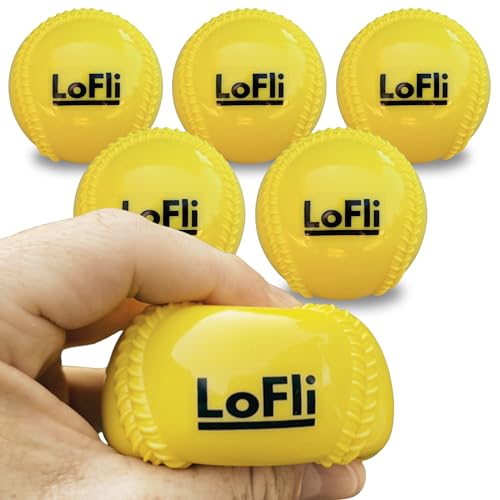
LoFli offers a regulation-weight training option with a reduced flight design, making it ideal for practice in backyards, parks, gyms, and other constrained spaces. The raised seams simulate real pitching grips, and the soft construction supports batting practice, grounders, and fielding work in one versatile training ball.
Who it’s for: Best for players who need to practice mechanics in compact spaces without sacrificing the feel of a real baseball. Caution: Because it is a lighter ball, it’s less effective for building maximal bat speed compared to heavier options.
ZELUS 6-Piece Weighted Baseball Set

This progressive set includes six balls ranging from 3.5 oz to 35 oz. It enables players to begin with lighter weights to build proper mechanics and gradually advance to heavier weights to develop explosive power. The PVC construction with raised seams mirrors real baseball feel, aiding a smooth transfer from weighted drills to game swings.
Who it’s for: Choose this if you want a staged progression that matches a player’s development arc. Caution: The widest-weight ball is very heavy and should be introduced only after a solid foundation is established.
Buying Guide: Key Considerations For Youth Weights
What weight is right for my youth player?
Begin with lighter options (e.g., 12–16 oz) for beginners to learn mechanics. Progress to heavier variants (up to 35 oz in multi-set options) as form improves. Avoid jumping to too heavy a ball too soon to prevent arm strain.
What diameter should I choose?
Standard baseball size (about 2.86–3 inches) is typical for transition to game-ready feel. Some 2.85-inch options fit small spaces and younger players who benefit from slightly lighter handling.
Durability and construction
Prefer PVC shells with reinforced seams and a durable fill to endure repeated drills. Balanced weight distribution helps players feel even feedback across swings, pitches, and throws.
Drills and practice goals
Use lighter sets for swing mechanics and bat path, midweights for power development, and multi-weight sets for progressive strength and control. Combine hitting, throwing, and fielding drills for comprehensive skill-building.
Space and safety considerations
In small spaces, look for reduced-flight or lighter options to minimize risk. Always supervise junior players during weighted-ball use and ensure proper warmups to prevent overuse injuries.
Progression planning
Plan a training cycle: 1–2 weeks focusing on mechanics with lighter balls, then 3–4 weeks gradually introducing heavier weights. Track improvements in bat speed, contact consistency, and throwing form.
FAQ
- Are weighted baseballs safe for youth players? Yes, when used with proper supervision, appropriate weights, and gradual progression to avoid overuse injuries.
- What weight should a beginner start with? Start with around 12–16 oz, depending on age and strength, then progress as form improves.
- Can weighted balls replace regular batting practice? They should complement standard practice, not replace it. They help with power development and mechanics when used correctly.
- Is a larger diameter better for practice? A standard baseball diameter helps players translate practice into game situations, though some spaces benefit from slightly smaller practice balls.
- How many balls are ideal in a set? A six-ball set is common, offering progression options without clutter, though sets vary by weight range and drill goals.