Best Basketball Net for Fence: Durable Backstops and Rebound Nets for Yard Practice
Answering the question “which basketball nets for a fence or backyard setup deliver reliable rebound and safe boundaries?” this guide highlights five top options. These picks are ideal for backyard players, youth leagues, and households with driveways or garden boundaries. Each product section explains who it’s best for and why it stands out, plus a practical limitation to consider. A quick summary table follows to help you compare at a glance.
| Product | Best For | Why It Stands Out |
|---|---|---|
| MR Ball Stop Net System 30’x12’ | Backyard practice with multi-sport use | 2-in-1 design, quick switch between socketed and freestanding; robust construction |
| MR Ball Stop Net System 20’x12’ | Versatile backstop for indoor/outdoor spaces | Same 2-in-1 concept in a smaller footprint; durable materials |
| ZivPlay Basketball Net Catcher 12×10 ft | Universal backyard rebounder for various hoop systems | Largest netting size among options; compatible with round and square poles |
| MegaNets Heavy Duty 12×10 ft Backstop Net | Weather-resistant yard protection and practice | UV-resistant nylon and alloy frame offer long-term use |
| Franklin Sports XL Defender Pro Backstop | Foldable, portable practice on any system | Easy setup and compact storage for frequent movers |
MR Ball Stop Net System 30’x12’: Backstop And Multi-Sport Net

- Best for: Backyards or campuses needing a versatile barrier for multiple sports.
- Why selected: It combines a 2-in-1 design with a backstop system that adapts quickly from socketed to freestanding, enabling flexible placement without extra equipment. Constructed with powder-coated steel and 420D PU-coated knotless polyester net, it endures repeated hits and resists tipping.
- Limitation: Setup and adjustment may take up to a few minutes, and weight may require stable anchoring on uneven surfaces.
MR Ball Stop Net System 20’x12’: Compact Backstop

- Best for: Smaller practice areas or youth programs needing a compact barrier.
- Why selected: Similar 2-in-1 versatility with a robust construction ideal for indoor or outdoor flat surfaces.
- Limitation: Slightly reduced width may limit ball containment for higher-volume shots.
ZivPlay Basketball Net Catcher 12×10 ft

- Best for: Backyard rebounders that need universal compatibility with hoop systems.
- Why selected: The largest size among typical net catchers and universal pole compatibility reduce compatibility headaches with various hoops.
- Limitation: Size may require more space and may not fit every fence configuration without adjustment.
MegaNets Heavy Duty 12×10 ft Backstop Net

- Best for: Outdoor yards needing durable weather resistance.
- Why selected: High-strength alloy frame and UV-resistant nylon net provide long-term use and reliable ball containment against tough shots.
- Limitation: Heavier setup and longer installation time compared to lighter, portable nets.
BluBrk Driveway Net: 28 Ft Safety Barrier

- Best for: Driveway play to keep basketballs off the street.
- Why selected: A wide, flexible boundary designed to stop most rolling balls before they reach the road, with stable framing to absorb impact.
- Limitation: Primarily designed for driveway boundaries, not full court backdrops or multi-sport use.
Franklin Sports XL Defender Pro Backstop
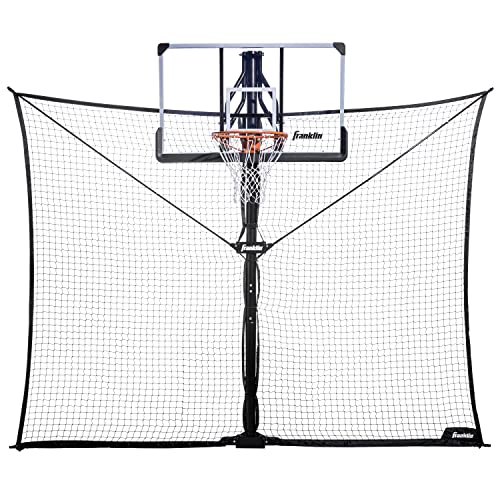
- Best for: Portable practice on various hoop setups with quick attachment.
- Why selected: Foldable and easily set up, designed to maximize practice time with minimal setup effort.
- Limitation: May not cover a large area as effectively as bigger backstops.
Buying Guide: What To Consider When Choosing A Basketball Net For Fence Or Backyard
- Purpose and space: If you need a full backstop that prevents balls from leaving the court area, choose larger, more secure nets. For casual driveway play, consider smaller or portable models.
- Surface compatibility: Some nets are designed for flat indoor or outdoor surfaces; ensure your fence or court area matches the product’s mounting options.
- Material and durability: Look for powder-coated steel or alloy frames and weather-resistant nets (polyester or nylon) to withstand outdoor conditions.
- Ease of setup: 2-in-1 designs that switch between socketed and freestanding configurations save time and space.
- Portability: If you regularly relocate the net, consider foldable or light-weight options with quick assembly.
- Containment capability: Assess the net size (width x height) to ensure it can catch and return most shots without frequent adjustments.
- Maintenance: Check if the netting is knotless or has reinforced seams for longer life under heavy use.
Frequently Asked Questions
- What size backstop do I need for a standard backyard court?
– A typical backyard backstop ranges from 10×10 ft to 12×12 ft, but larger setups (12×10, 12×12) offer better containment for powerful shots. - Are 2-in-1 ball stop nets really easy to move?
– Yes. 2-in-1 designs switch between socketed and freestanding configurations in minutes, reducing setup time for multi-sport use. - Can these nets protect surrounding areas like gardens or driveways?
– Yes, several models are designed to prevent stray balls from leaving the play area, safeguarding nearby spaces and reducing recoveries. - Do these nets require professional installation?
– Most are designed for at-home setup with basic tools; however, large installations may benefit from additional anchoring or help. - Which material lasts longest outdoors?
– Nets with UV-resistant nylon or polyethylene and powder-coated frames typically offer the best longevity in sun and weather exposure.