Best Home Gym Benches for Working Out: Top Picks for Every Space
Need a reliable bench for working out at home? This guide compares five versatile, space-saving benches that suit different training goals and room sizes. Whether you’re a beginner building a routine or a seasoned lifter optimizing a compact gym, these picks offer solid stability, multiple incline angles, and easy fold-and-store designs. Each option is chosen for durability, ease of use, and suitability for common exercises like bench presses, dumbbell work, core training, and full-body workouts.
Summary table of selected products:
| Product | ||
|---|---|---|
| NICEPEOPLE Adjustable Weight Bench | Compact home gym with multiple backrest angles | 8 positions, 660 lbs capacity |
| YOLEO Adjustable Weight Bench | Ready-to-use setup and high capacity | 827 lbs capacity, 98% pre-assembled |
| FLYBIRD WB5 Weight Bench | Full-range motion with rich angle options | Up to 800 lbs, 144 positions |
| XCHIEF Adjustable Weight Bench | Heavy-duty selection for serious lifting | 1000 lbs capacity, 9 back positions |
| FitinOne Adjustable Weight Bench | Space-saving, multi-function bench | 660 lbs capacity, 3-section folding |
NICEPEOPLE Adjustable Weight Bench

This bench is designed for home gyms and beginners. It supports bench press, dumbbell work, core training, and full-body routines in a compact frame suitable for apartments. It offers 8 backrest angles for precise full-body training and a fast-adjust groove for quick transitions. The long backrest is intended to fit about 90% of users, improving comfort and stability during sit-ups and presses. Best for: newcomers building a foundational routine in limited space. Limitation: a compact frame may limit certain powerlifting setups for very tall users.
YOLEO Adjustable Weight Bench

YOLEO emphasizes ease of setup with 98% pre-assembly and a lightweight frame that still supports heavy work. It has an ASTM-certified capacity of 827 lbs with a maximum user weight of 330 lbs. Features include 84 adjustable positions across back, seat, and leg angles, enabling flat, incline, and decline work. Best for: users who want a quick-to-use bench that accommodates a wide range of angles without extensive setup. Limitation: some users may prefer a broader backrest for certain shoulder-focused movements.
FLYBIRD WB5 Weight Bench

FLYBIRD offers an 800-pound capacity with a robust frame and a 90° upright position for isolated shoulder work. The bench provides 144 adjustable positions ranging from -30° to 90°, enabling versatile full-body training. The extended 30-inch backrest and 15.7-inch seat pad promote proper form and reduce lower-back arching during heavy presses. Best for:lifters seeking a balance of long-term durability and a wide angle range. Limitation: heavier weight may be less ideal for ultra-compact spaces when stored upright.
XCHIEF Adjustable Weight Bench

XCHIEF is built for serious strength training, offering a 1000-pound weight capacity and a highly adjustable backrest with 9 positions plus multiple preacher pad options. The premium steel frame supports demanding routines, and the bench uses comfortable PU leather and dense foam padding for longer sessions. Best for: advanced lifters needing maximal load capacity and precise angle control. Limitation: high-capacity frame can take more space than lighter benches.
FitinOne Adjustable Weight Bench
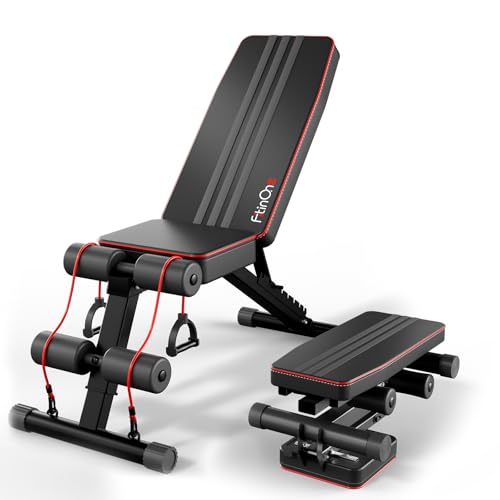
FitinOne focuses on space-saving design with a 20% footprint reduction and a foldable mechanism. It supports up to 660 pounds and functions as a bench press stool, flat bench, and supine board, making it a versatile option for small home gyms. Best for: apartment dwellers and anyone needing easy storage. Limitation: 3-section folding may require careful final positioning for flat workouts.
Buying Guide: Key Purchase Considerations
- Weight capacity: Match the bench’s rated load to your current and near-future lifting plans. Heavier-duty benches offer more longevity for serious lifters.
- Backrest and seat angles: Look for a wide range of angles (incline, flat, decline) to support chest, shoulders, and core training.
- Frame construction: Steel frames with triangulated supports typically deliver better stability and less wobble during heavy lifts.
- Foldability and footprint: If space is tight, prioritize benches with fast-fold systems and compact storage dimensions.
- Comfort: Padded backrests and seats reduce fatigue and improve form, especially for longer sessions.
- Assembly needs: Some benches arrive nearly ready-to-use; others require more setup. Consider your preferred level of assembly.
- Compatibility: If you already own a rack or rack-compatible dumbbells, ensure the bench height and pad placement work with your existing gear.
FAQ
- What makes a bench good for beginners?
A bench with multiple adjustable angles, simple setup, and a sturdy but not overly heavy frame is ideal for new lifters learning form. - Is a higher weight capacity always better?
Not always. Choose a capacity that matches current needs and allows for progression without overbuilding the bench’s weight class. - Should I buy a foldable bench?
Foldable benches save space and are convenient for small rooms, but ensure folding mechanisms are durable and safe. - How important is backrest length?
A longer backrest often provides better head and upper back support, contributing to stability during ab work and presses. - Can I use a weight bench for legs and core too?
Yes, most benches support a full-body routine when paired with dumbbells, barbells, or bodyweight moves depending on the model. - Do benches need assembly tools?
Some arrive ready to use, others require minimal assembly. Check the product page for pin tools and manuals.