Best Tripod for Spotting Scope and Rifle: Stable, Versatile Mounts for Outdoors
The top choice is a versatile, sturdy tripod system designed to support spotting scopes, binoculars, cameras, and rifles. This guide highlights five options that balance height, portability, and durability for outdoor use. Each listing explains who benefits most, and where to exercise caution based on the product data provided.
| Product | Best For | Key Range |
|---|---|---|
| Lusweimi Binocular Tripod | Serious observers needing tall reach and phone compatibility | 16.9″ to 69″ (up to 72″ with equipment) |
| Arsoer 69” Tripod for Spotting Scopes | Bird watching and wildlife viewing on varied terrain | 16.9″ to 69″ (up to 73″ with scope) |
| Nietoto 2 in 1 Camera Tripod | Outdoor hunting or shooting training with rifle adaptability | 16.5″ to 68″ (folds to 16.5″) |
| LCNCY Spotting Scope Tripod | Multi-device compatibility, compact travel | 18″ to 62″ |
| FANAUE Carbon Fiber Shooting Tripod | Rifle and spotting scope with Arca Swiss setup | Height adjustable via 4-section legs |
Lusweimi Binocular Tripod: Tall, Stable, Multi-Device Adapter

Best for: observers who require a tall, sturdy platform and a dedicated phone holder. This aluminum tripod adjusts from 16.9 inches to 69 inches, reaching 72 inches in use with optics. The 10 cm rotatable phone holder adds convenience for field updates. It includes a binocular adapter and two quick-release plates for flexible mounting. A detachable head helps reduce storage size. The design emphasizes stability with a load-bearing hook for gear or packs in windy conditions.
Why selected: It offers a robust height range, a dedicated phone holder, and a rectangular tube build for rigidity. The included adapters support a wide set of binocular models that use 1/4″ threads, making it versatile for different gear. The combination of portability and stability suits long-range sit-and-scan scenarios.
Caution: Ensure your binoculars have a 1/4″ threaded hole, and check thread depth compatibility with the adapter, as different brands vary. Carrying balance and stability depend on load distribution and setup on uneven ground.
Arsoer 69” Tripod: Versatile for Birding and Wildlife

Best for: bird watchers and outdoor enthusiasts who value a long reach and quick setup. This aluminum tripod ranges from 16.9 to 69 inches, extending to 73 inches with a birding scope. It includes a 10 cm rotatable phone holder and a detachable head that folds compactly for storage. A load-bearing hook adds stability in adverse weather, and its universal rotating mobile holder supports multiple devices.
Why selected: The tool-free height adjustment and sturdy metal construction provide dependable performance across varied terrains. The added adapters help accommodate binoculars, spotting scopes, cameras, and phones, making it a strong all-around choice for field observations.
Caution: As with other models, verify thread compatibility for accessories and ensure the base is stable on uneven ground to prevent tipping when fully extended.
Nietoto 2 in 1 Camera Tripod: 2-in-1 for Shooting and Spotting

Best for: outdoor shooters who want a dual-purpose platform for both cameras and rifles. This 68″ adjustable tripod has a 360° rotatable V-Yoke Rest and a 3/8″ screw for center-column mounting, enabling quick conversion from camera setup to rifle shooting. Maximum leg diameter is 26 mm, providing solid support, with 3-section legs and flip-locks for rapid height changes. Folded length is compact for transport.
Why selected: The 36 mm CNC ball head would provide strong locking and smooth panning, enhancing precision for both photography and shooting applications. The ability to switch from glassing to shooting quickly is a clear advantage in dynamic outdoor environments.
Caution: Ensure the center-column mount and ball head tolerances align with your specific rifle or camera accessories to avoid misalignment under recoil or movement.
LCNCY Tripod With V Yoke: Multi-Device Adaptability

Best for: users who want a compact, travel-friendly solution without sacrificing compatibility. This tripod offers an 18″ to 62″ height range and weighs about 2.2 lbs, making it easy to carry in bags. It ships with a binocular adapter and a distant 360° rotation capability via a fluid head, making it compatible with binoculars, monoculars, rifles, spotting scopes, telescopes, cameras, and more.
Why selected: Its broad device compatibility and fluid head design enable straightforward use across different optics. The lighter weight is a practical benefit for day trips and hikes where weight matters.
Caution: When traveling with a full load, verify stability on uneven ground, and be mindful of lightweight legs that may flex under heavier gear.
SVBONY SV28 Spotting Scope Tripod: Solid Starter Option
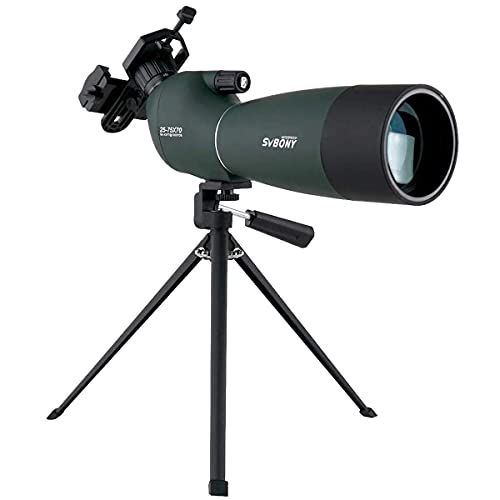
Best for: beginners and enthusiasts seeking a straightforward spotting scope setup with good light gathering. The SV28 offers a 25-75x magnification range, a 70 mm objective, and a weather-resistant construction. It includes a phone adapter to capture field moments and a sunshade to reduce glare in bright environments.
Why selected: This option emphasizes ease of use and practical features for first-time buyers. It provides a reliable balance of optical compatibility and portability for travel and field sessions.
Caution: Avoid overextending the tripod in windy conditions or on unstable surfaces to maintain image stability and safety of equipment.
Buying Guide
What height range do I need?
Choose a tripod that allows lowest comfortable viewing height and tall enough to glass without crouching. If you frequently shoot from prone or seated positions, prioritize models with 16.5″ to 68″ or more extended ranges.
Is Arca Swiss compatibility important?
Arca Swiss quick-release systems enable fast, secure mounting and easy swapping between optics. If you use multiple devices, a tripod with Arca-compatible plates or quick-release options saves time in the field.
How important is weight and portability?
Weight affects transport during hikes or field trips. Lighter tripods (around 2–4 lbs) are easier to carry, but heavier designs typically offer greater stability for larger spotting scopes and rifles.
What about stability in wind?
Look for load-bearing hooks, sturdy leg construction, and a design that reduces wobble. A hook for bags or gear adds stability in gusty environments.
What devices need mounting?
Consider whether you need compatibility with binoculars, spotting scopes, cameras, or phones. Models bundled with adapters for 1/4″ threads and universal holders save setup time.
What are practical cautions to consider?
- Thread compatibility varies by brand; verify 1/4″ or 3/8″ screw compatibility with your gear.
- Ensure the tripod head supports your load capacity to avoid tipping or creeping under recoil.
- Check folded length for transport and how compact the head is when stowed.
Summary of buying considerations
- Height range vs. portability
- Device compatibility and adapters included
- Stability features like load hooks and robust leg design
- Head type (ball head, fluid head) and panning controls
FAQ
- Q: Can I use a spotting scope with a standard binocular tripod? A: It depends on the screw thread and the head’s load capacity; verify compatibility before mounting.
- Q: Do these tripods work with rifles? A: Some models include rifle-adaptable heads or V Yoke designs; check the 3/8″ center-column compatibility and stability for your setup.
- Q: Is a heavier tripod better for shooting stability? A: Generally, yes, but consider balance with travel needs and field use. A heavier option improves stability on uneven ground.
- Q: What is the advantage of an Arca Swiss system? A: It simplifies quick mounting and cross-compatibility with multiple optics and accessories.
- Q: Should I prioritize a longer height or lighter weight? A: For long-range observing, prioritize height; for hikes and travel, prioritize weight and portability.
- Q: Are phone adapters necessary? A: If you occasionally capture field images, a phone holder adds convenience without sacrificing stability.